

Key Takeaways
- The working capital formula is simple: Current Assets − Current Liabilities. A positive result means you can cover short-term obligations; a negative result means you’re at liquidity risk.
- A working capital ratio between 1.5 and 2.0 is considered healthy for most businesses. Below 1.0 signals danger, while above 2.5 may indicate idle cash or excess inventory.
- Negative working capital demands immediate action: accelerate receivables collection, negotiate extended supplier payment terms, or secure short-term financing.
- The Cash Conversion Cycle (CCC = DIO + DSO − DPO) measures how long cash is tied up in operations. Cutting it from 55 days to 40 days frees up cash without adding a single new sale.
- Growing receivables or inventory increases net working capital on paper but drains real cash, which is exactly how profitable businesses end up unable to make payroll.
- In M&A deals, working capital becomes a direct negotiating lever: if NWC at closing falls below the agreed peg, the buyer receives a post-closing price adjustment; often a six-figure difference.
- The formula has hard limits: it counts 180-day-past-due receivables and obsolete inventory the same as cash, so always evaluate asset quality alongside the raw number.
Most business owners don’t realize their company is bleeding cash until payroll is due and the account is short. The working capital formula fixes that blind spot. It gives you one clear number that shows whether your business can cover its short-term obligations, without scrambling for credit at the worst possible moment.
This guide walks you through the formula step by step, with real examples you can apply today.
What Is Working Capital? (Plain-English Definition)
Working capital is the money your business has available to fund day-to-day operations. Think of it as your financial cushion; what’s left after you subtract what you owe short-term from what you own short-term.
The working capital formula captures this in one equation: current assets minus current liabilities. A positive number means you’re solvent day-to-day. A negative number means you’re stretched.
For a deeper breakdown of the concept itself, read our full guide on what working capital is and why it matters.
The Working Capital Formula
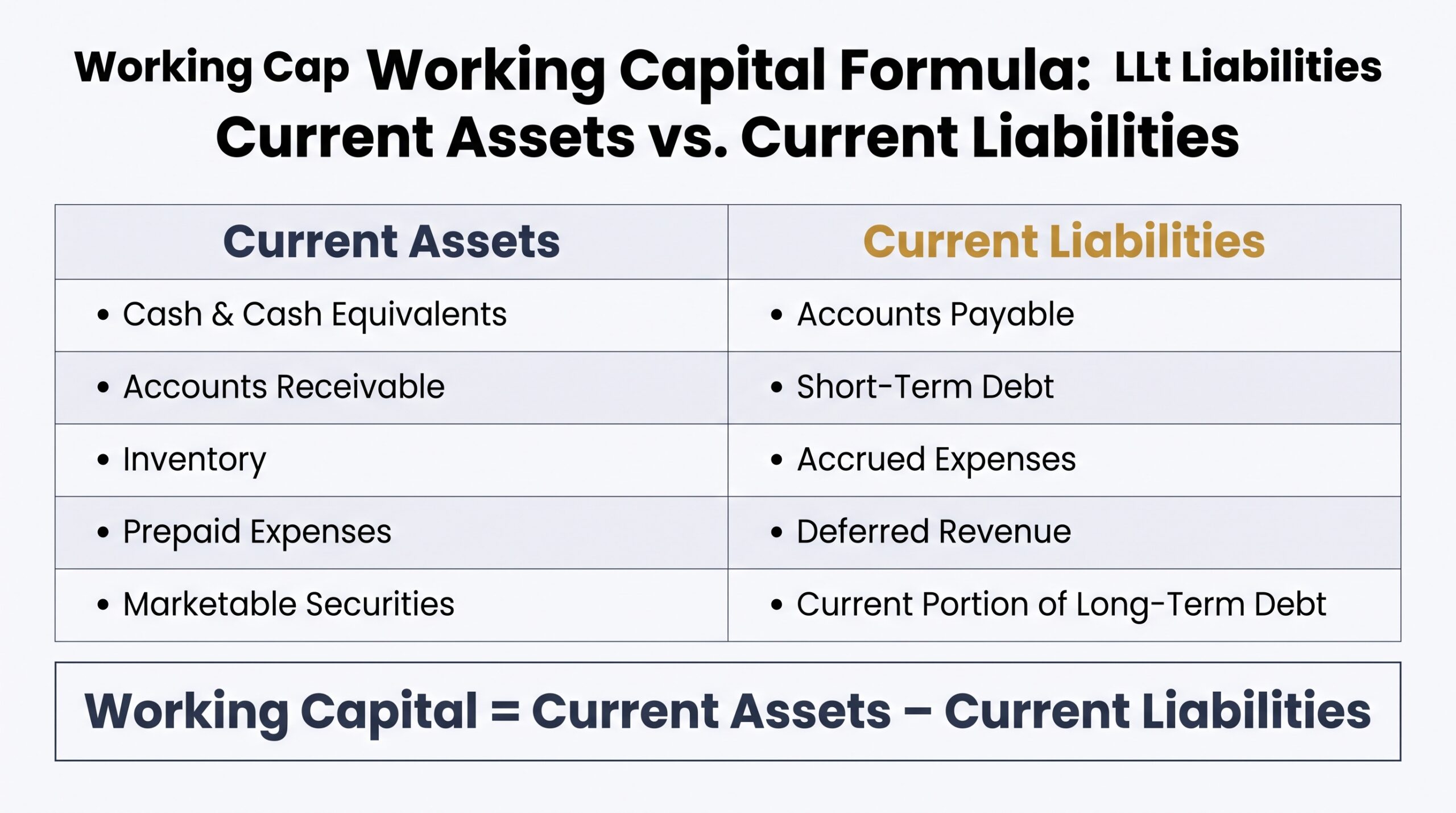
Formula at a Glance
The working capital formula is straightforward:
Working Capital = Current Assets − Current Liabilities
Current assets are everything your business owns or will convert to cash within 12 months. Current liabilities are everything you owe within the same window. The gap between them is your working capital.
Breaking Down the Formula: Current Assets vs. Current Liabilities
Both Corporate Finance Institute and JPMorgan define these components consistently. Here’s what goes into each side of the working capital equation:
| Current Assets | Current Liabilities |
|---|---|
| Cash & cash equivalents | Accounts payable |
| Accounts receivable | Short-term debt |
| Inventory | Accrued expenses |
| Prepaid expenses | Deferred revenue |
| Marketable securities | Current portion of long-term debt |
How to Calculate Working Capital Step by Step
You don’t need a finance degree to run this calculation. Pull up your balance sheet and follow these four steps.
Step 1 — Gather the Balance Sheet
Open your most recent balance sheet. In QuickBooks, Xero, or any cloud accounting tool, this is usually under Reports. You only need the “current” section of both sides.
Step 2 — Total All Current Assets
Add up everything in the current assets section: cash, accounts receivable, inventory, prepaid expenses, and marketable securities. One combined number.
Step 3 — Total All Current Liabilities
Do the same for current liabilities: accounts payable, short-term debt, accrued expenses, deferred revenue, and any current portion of long-term debt.
Step 4 — Subtract Liabilities from Assets
Apply the working capital formula directly:
Working Capital = Total Current Assets − Total Current Liabilities
That number tells you exactly where you stand today.
Working Capital Calculation Example
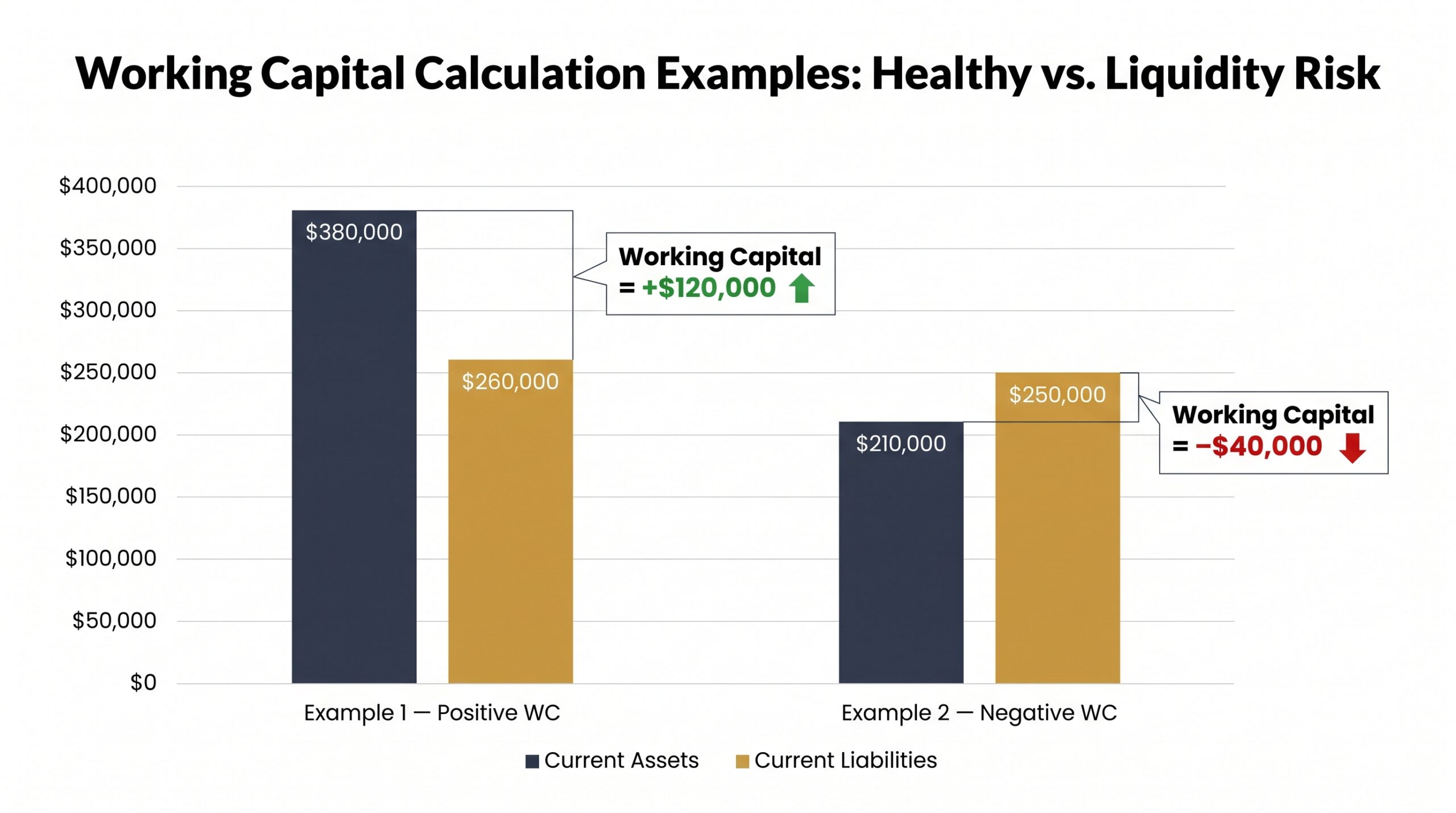
Example 1: Positive Working Capital (Healthy Business)
A manufacturing company with $2M in annual revenue pulls its balance sheet and finds:
- Current assets: $380,000 (cash $90k, receivables $180k, inventory $110k)
- Current liabilities: $260,000 (payables $140k, accrued expenses $80k, short-term debt $40k)
Working Capital = $380,000 − $260,000 = $120,000
That $120,000 buffer means the business can cover its near-term obligations and still fund day-to-day operations, without touching a credit line.
Example 2: Negative Working Capital (Liquidity Risk)
A similar business hits a slow quarter. Now:
- Current assets: $210,000
- Current liabilities: $250,000
Working Capital = $210,000 − $250,000 = −$40,000
Negative $40,000 means liabilities outpace liquid assets. Payroll and supplier payments are at risk.
The owner needs to accelerate receivables collections, negotiate extended payment terms, or access short-term financing fast.
What Are the Four Main Components of Working Capital?
According to Backd and Wall Street Mojo, four components drive most working capital calculations for small businesses.
Cash and Cash Equivalents
Your most liquid asset. This is money sitting in operating accounts or short-term instruments you can access immediately to cover obligations. No conversion needed, it’s ready to use.
Accounts Receivable
Revenue you’ve earned but haven’t collected yet. Here’s what most guides skip: slow-paying customers can make your working capital look healthy on paper while your actual cash position is dangerously tight.
Inventory
Goods you hold for sale. Excess inventory ties up cash without generating returns until it moves, which means a warehouse full of product isn’t the same as money in the bank.
Accounts Payable
Unlike the first three, accounts payable is a current liability. It’s money you owe suppliers, and it sits on the right side of the working capital equation, reducing your net position.
Understanding how each component behaves lets you manage the working capital formula proactively, not just calculate it after the fact.
Working Capital Ratio Formula
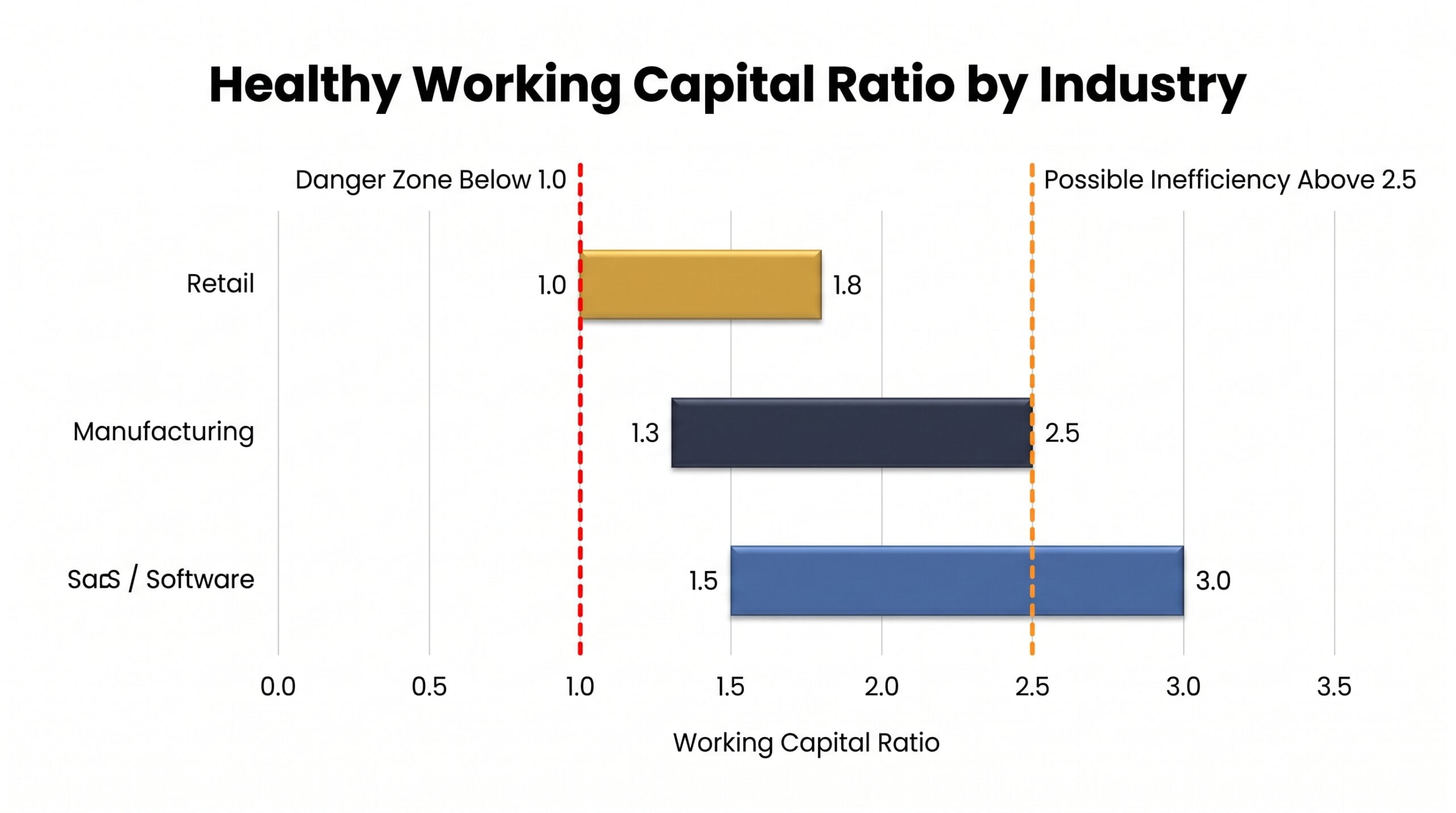
How to Calculate the Working Capital Ratio
There’s a ratio version of the working capital equation that’s easier to benchmark across businesses:
Working Capital Ratio = Current Assets ÷ Current Liabilities
Using our earlier example: $380,000 ÷ $260,000 = 1.46. That single number tells lenders and operators how many dollars of assets back every dollar of short-term debt.
What Is a Good Working Capital Ratio?
Benchmarks vary by industry, according to Crestmont Capital and DCF Modeling:
| Industry | Healthy Ratio Range |
|---|---|
| Retail | 1.0 – 1.8 |
| Manufacturing | 1.3 – 2.5 |
| SaaS / Software | 1.5 – 3.0 |
A ratio above 2.0 isn’t always good news. It can signal idle cash or excess inventory dragging on efficiency. For a full breakdown, read our guide on the working capital ratio.
Net Working Capital (NWC): Definition and Formula
Working Capital vs. Net Working Capital: Are They Different?
The honest answer is: not really. Business owners, accountants, and lenders use “working capital” and “net working capital” interchangeably in most practical contexts. Same formula, same output.
The distinction shows up in financial modelling. Some analysts define NWC more narrowly, excluding cash and short-term debt to isolate operating efficiency. That version is less relevant for day-to-day small business management.
Net Working Capital Formula
Standard definition used by most practitioners:
Net Working Capital = Current Assets − Current Liabilities
Narrow financial modelling definition:
Net Working Capital = (Current Assets − Cash) − (Current Liabilities − Short-Term Debt)
For running your business, stick with the standard working capital formula. The narrow version is a tool for valuation analysts, not operations.
For a deeper look at how NWC fits into financial analysis, see our full guide on net working capital.
Change in Working Capital: What It Means and Why It Matters
Change in Working Capital Formula
Calculating working capital at a single point in time is useful. Tracking how it moves is more powerful.
Change in Working Capital = Current Period WC − Prior Period WC
If your working capital was $120,000 last quarter and it’s $90,000 today, that $30,000 decline is worth investigating; something shifted, and you want to know what.
How Change in Working Capital Appears on the Cash Flow Statement
This is where business owners regularly get tripped up. On the cash flow statement, the relationship is counterintuitive:
- Increase in NWC = use of cash (negative impact on cash flow)
- Decrease in NWC = source of cash (positive impact on cash flow)
Growing receivables or inventory builds NWC on paper but drains actual cash. That gap between profit and cash is how healthy-looking businesses run into payroll problems.
For a full walkthrough, see our guide on change in net working capital.
Working Capital Metrics: Full Formula Reference Table
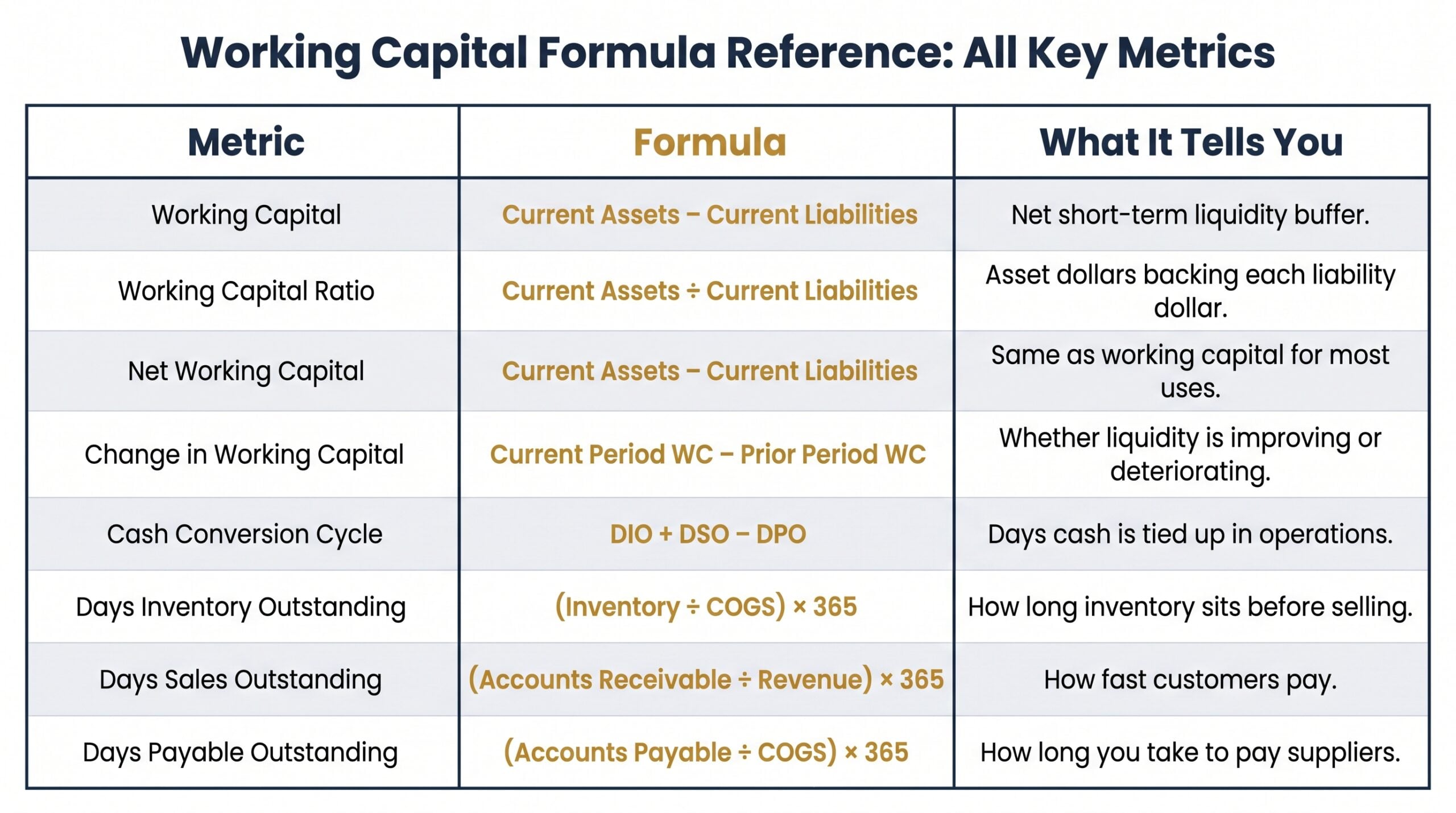
Every working capital formula you’ll encounter, in one place.
| Metric | Formula | What It Tells You |
|---|---|---|
| Working Capital | Current Assets − Current Liabilities | Net short-term liquidity buffer |
| Working Capital Ratio | Current Assets ÷ Current Liabilities | How many asset dollars back each liability dollar |
| Net Working Capital | Current Assets − Current Liabilities | Same as working capital for most practical uses |
| Change in Working Capital | Current Period WC − Prior Period WC | Whether liquidity is improving or deteriorating |
| Cash Conversion Cycle | DIO + DSO − DPO | Days cash is tied up in operations |
| Days Inventory Outstanding (DIO) | (Inventory ÷ COGS) × 365 | How long inventory sits before selling |
| Days Sales Outstanding (DSO) | (Accounts Receivable ÷ Revenue) × 365 | How fast customers pay |
| Days Payable Outstanding (DPO) | (Accounts Payable ÷ COGS) × 365 | How long you take to pay suppliers |
Working Capital Cycle Explained
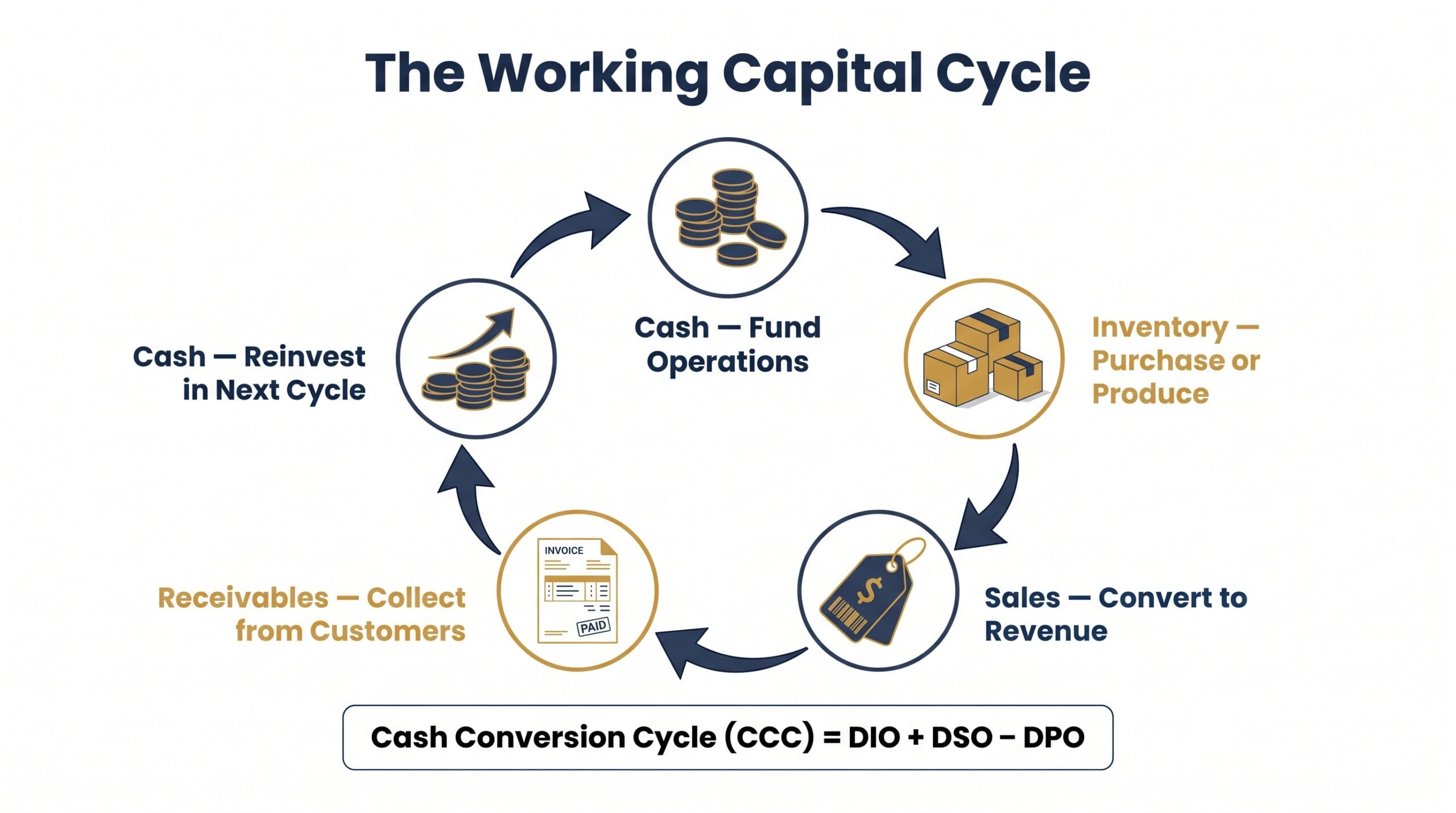
Your working capital doesn’t sit still. It moves through a continuous operational loop, described by Wall Street Prep and Corporate Finance Institute as the working capital cycle:
- Cash is used to purchase raw materials or stock
- Inventory is produced or held for sale
- Sales convert inventory into revenue
- Receivables are collected from customers
- Cash returns to fund the next cycle
The Cash Conversion Cycle (CCC) quantifies how long this loop takes:
CCC = DIO + DSO − DPO
A manufacturer with 45-day inventory, 30-day receivables, and 20-day payables runs a 55-day CCC. Shrink that number, and you free up cash without changing revenue at all. Every improvement to your CCC directly strengthens the inputs in your working capital calculation.
Working Capital Peg in M&A Transactions
If you’re ever buying or selling a business, the working capital formula stops being a reporting tool and becomes a negotiating weapon. According to Auxo Capital Advisors and KMCO, most M&A deals include a working capital peg: an agreed NWC target the seller must leave in the business at closing.
The logic is straightforward. Buyers need sufficient liquidity to operate from day one. Without a peg, sellers could drain receivables and delay payables before closing, handing over a technically profitable business with no cash to run it.
The peg is typically set using a trailing 12-month average of NWC, smoothing out seasonal swings. At closing, actual NWC is measured against the peg:
- NWC above peg: seller receives a purchase price increase
- NWC below peg: buyer receives a post-closing adjustment credit
A working capital calculation that looks routine in day-to-day operations can become a six-figure negotiation point in a transaction. Don’t walk into a deal without understanding where you stand.
Limitations of the Working Capital Formula
The working capital formula is essential, but it’s not complete. As noted by Chris Arndt and FinXL, four limitations matter in practice:
- Asset quality. Positive working capital means nothing if your receivables are 180 days past due or your inventory is obsolete. The formula counts them the same as cash.
- Snapshot problem. A balance sheet captures one day. A retailer on December 26th looks completely different from the same retailer on November 1st. One date rarely tells the full story.
- High WC isn’t always good. A ratio of 3.5 can signal excess inventory or idle cash that should be deployed elsewhere.
- Classification differences. Two companies can define “current” differently, making working capital calculations across businesses misleading without digging into the notes.
Use the working capital equation as a starting point, not a verdict.
How to Improve Working Capital
Speed Up Receivables Collection
Invoice immediately upon delivery and offer early payment discounts of 1–2%. Cutting your DSO from 45 days to 30 days can add tens of thousands in available cash, without a single new sale.
Extend Payment Terms With Suppliers
Negotiate net-45 or net-60 terms instead of net-30. Every extra day you hold cash before paying suppliers improves your working capital calculation at no cost. It’s one of the simplest levers you have.
Reduce Inventory Levels
Excess inventory is cash sitting in a warehouse. Tighter reorder points and just-in-time purchasing convert idle stock into usable liquidity, money you can actually deploy.
Use Working Capital Financing
Sometimes operational improvements aren’t fast enough. Working capital loans and SBA working capital loans can bridge the gap while you fix the underlying cycle.
For a deeper strategy playbook, see our guide on working capital management.
Frequently Asked Questions
How do you calculate working capital?
Use the working capital formula: Current Assets minus Current Liabilities. Pull both figures from your balance sheet. A positive result means you can cover short-term obligations; negative means you can’t.
What is a good ratio for working capital?
Most analysts consider 1.5 to 2.0 healthy. Below 1.0 signals liquidity risk. Above 2.5 may indicate idle assets or poor capital deployment.
What are the four main components of working capital?
Cash, accounts receivable, inventory, and accounts payable. The first three are current assets; accounts payable is the primary current liability in most working capital calculations.
What do you mean by working capital?
Working capital is the cash and liquid assets available to fund day-to-day operations after short-term debts are accounted for. It measures whether your business can meet near-term obligations without external financing.
Understanding the working capital formula is step one. Putting it to work is step two. If your working capital calculation is tighter than you’d like, Nanotom Capital provides fast, flexible working capital financing built for small and mid-market businesses. Apply today and find out what’s available for your business.

Founder of Nanotom Capital & Nanotom Labs