Key Takeaways
- Only 51% of small business loan applicants get fully approved, and credit issues account for 26–45% of all denials, making your credit score the single most important factor to fix before applying.
- Minimum score requirements vary sharply by loan type: traditional banks require 680+, SBA 7(a) loans need 650+, equipment financing accepts 600–650, and online lenders will work with scores as low as 500–600.
- Your credit score sets your interest rate, not just your approval odds. On a $50,000 loan, the difference between a 7% and 18% APR costs you over $14,000 in extra interest over 5 years.
- Lenders pull both your personal FICO and your business credit score; a new LLC has zero business credit history until it deliberately builds one through a D-U-N-S number and net-30 vendor accounts.
- Paying down revolving balances below 30% utilization can add 20–40 points to your personal FICO within 60 days, the fastest single lever most borrowers can pull.
- Prequalify with soft-pull lenders before submitting any formal applications; each hard inquiry can drop your score 3–10 points and stays on your report for up to 2 years.
- A Debt Service Coverage Ratio below 1.25x makes approval nearly impossible regardless of your credit score. Calculate yours before approaching any lender.
Only 51% of small business loan applicants get fully approved, according to the Federal Reserve’s 2024 Small Business Credit Survey. That means roughly half walk away empty-handed.
Understanding exactly what lenders want before you apply changes everything. This guide breaks down credit score requirements across every major loan type, shows you how scores affect your rate, and gives you a checklist to assess your approval odds right now.
Why Your Credit Score Is the First Thing Lenders Check
Lenders are making a bet on you. Credit scores give them a fast, standardized way to measure how likely you are to repay. Before they look at your revenue, your business plan, or anything else, your score tells them whether to keep reading.
The Federal Reserve’s data makes this concrete. Credit issues account for roughly 26–45% of all small business loan denials, the single most common reason applicants get rejected or receive worse terms than they expected.
The core logic isn’t complicated. A higher score signals lower default risk, which translates directly to better rates, higher loan amounts, and more lender options. Poor credit doesn’t just hurt your approval odds; it makes borrowing more expensive even when you do qualify.
Here’s what most guides skip: lenders often pull both your personal and business credit scores. Your personal score carries the most weight for newer businesses without an established credit history. We’ll cover exactly how both are evaluated, what ranges qualify for which loan types, and where you stand before you ever talk to a lender.
Personal vs. Business Credit Scores: Key Differences
Personal Credit Score (FICO): What It Is and How It’s Used
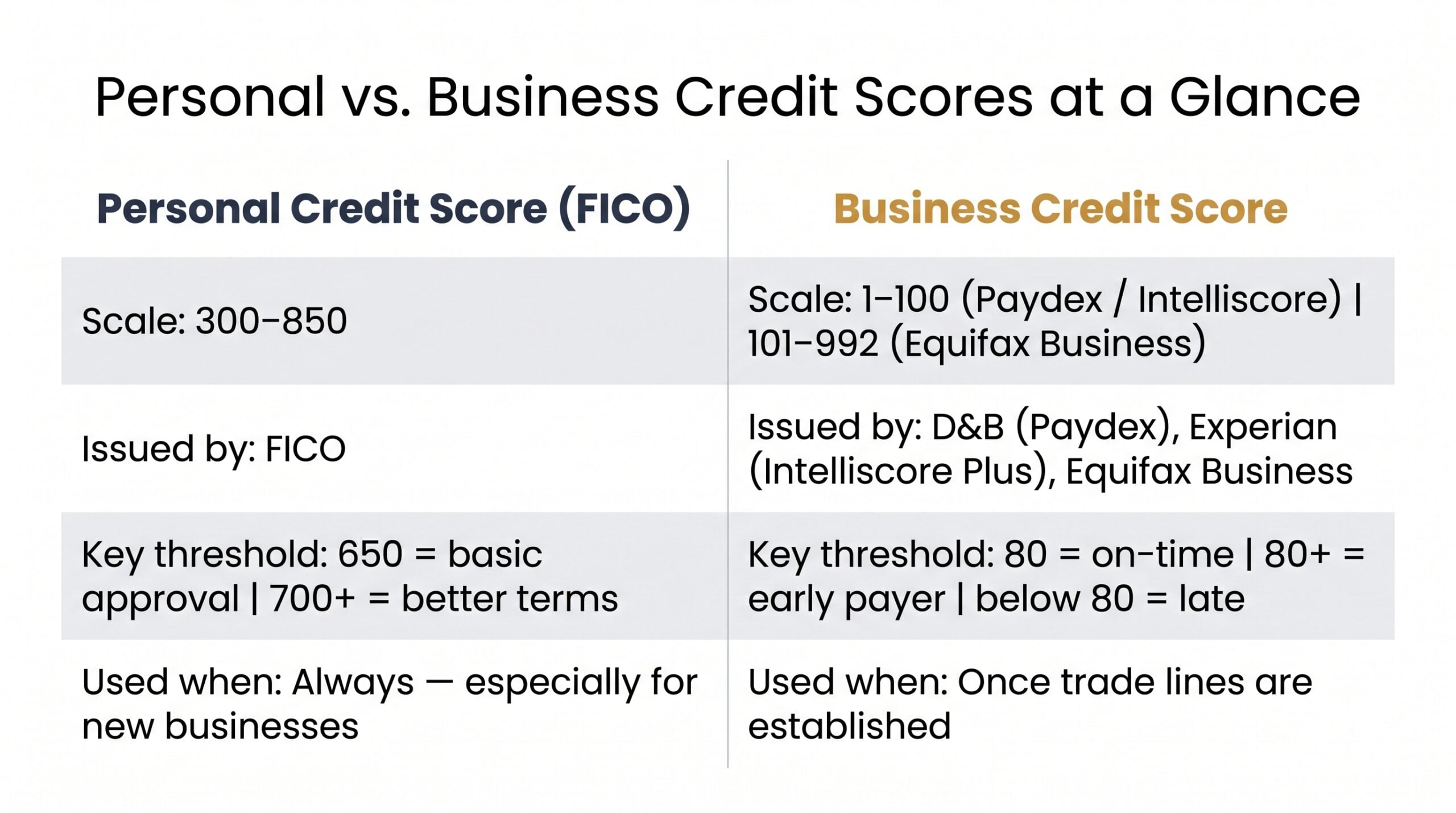
Your personal FICO score runs from 300 to 850. Most lenders treat 650 as a soft floor for basic approval, with 700+ unlocking meaningfully better terms.
For newer businesses without their own credit history, your personal FICO carries the most weight, and that’s most small businesses. Expect every lender to pull it regardless of how long you’ve been operating.
Business Credit Scores: Paydex, Experian Intelliscore, and Equifax Business
Business credit scores use completely different scales. Dun & Bradstreet’s Paydex runs 1–100. A score of 80 means you pay on time. Above 80 means you pay early. Below 80 signals late payments, a red flag for any lender evaluating your application.
Experian’s Intelliscore Plus also runs 1–100. Equifax Business uses a 101–992 scale. Higher is better on both.
Here’s the catch: a new LLC has zero business credit score until it establishes trade lines. No history means lenders fall back entirely on your personal FICO. Learn more about how business credit works vs. personal credit before you apply.
Credit Score Requirements by Loan Type: Full Comparison Table
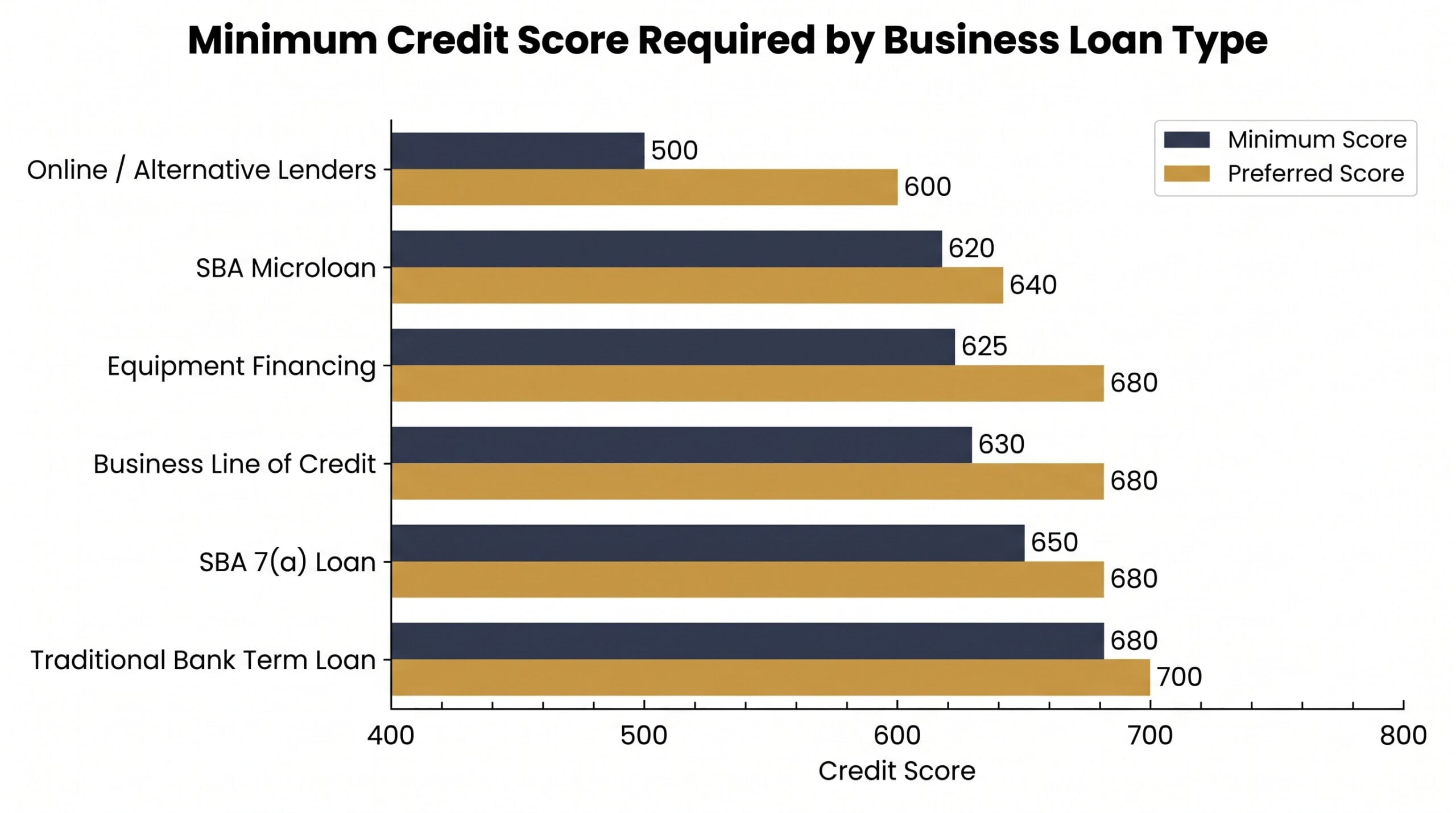
Use this as your quick-reference starting point. The details for each loan type follow below.
| Loan Type | Minimum Credit Score | Preferred Score | Typical APR Range |
|---|---|---|---|
| SBA 7(a) Loan | 650 | 680+ | 5–9% |
| Traditional Bank Term Loan | 680 | 700+ | 6–12% |
| Business Line of Credit | 620–640 | 680+ | 8–24% |
| Equipment Financing | 600–650 | 680+ | 7–20% |
| SBA Microloan | ~620 (some accept 500s) | 640+ | 8–13% |
| Online / Alternative Lenders | 500–600 | 600+ | 18–50%+ |
SBA 7(a) Loans
SBA 7(a) loans offer some of the lowest rates available, but lenders want a personal FICO of at least 650, with most preferring 680+. They’re best for established businesses needing $50K–$5M for working capital, expansion, or equipment. If your score is below 650, you’ll likely need to rebuild before applying.
Traditional Bank Term Loans
Banks set the highest bar. A 680 minimum is standard, and 700+ is where you’ll see competitive rates in the 6–12% range, per Bankrate. These loans suit businesses with 2+ years of operating history and strong revenue documentation.
Business Lines of Credit
Lines of credit offer more flexibility, and the credit score floor is slightly lower at 620–640. You’ll still want to target 680+, that’s where lenders offer higher limits and better draw terms. This product fits businesses managing irregular cash flow particularly well.
Equipment Financing
Because the equipment itself secures the loan, lenders accept scores as low as 600–650. The collateral reduces their risk significantly, making this one of the most accessible loan types for borrowers with fair credit.
SBA Microloans
SBA Microloans go up to $50,000 and are administered by nonprofit intermediaries, some of which accept scores in the 500s. Requirements vary by intermediary, per NerdWallet. These are designed specifically for startups and underserved borrowers who don’t qualify elsewhere.
Online and Alternative Lenders
Online lenders like Kabbage, OnDeck, and Bluevine accept scores starting at 500–600. The tradeoff is cost; APRs of 18–50%+ are common, per LendingTree. Speed and accessibility are the advantages here. Use these when traditional options aren’t available to you.
How Your Credit Score Affects Your Interest Rate
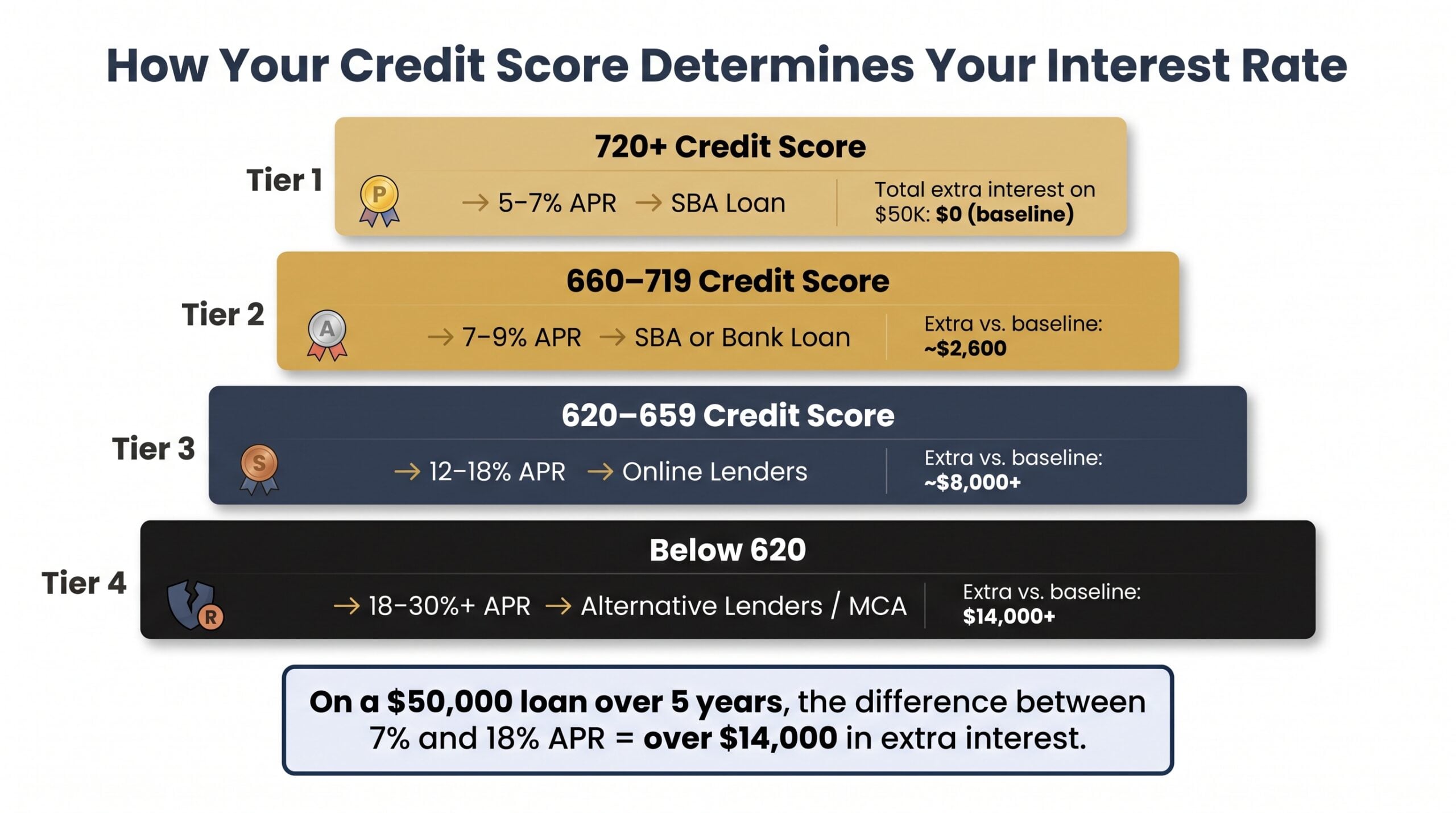
Your score doesn’t just determine approval. It determines what you pay for the next 3–7 years.
Most guides show you the minimum score to qualify and stop there. They don’t show you what that score actually costs over the life of the loan. Here’s how scores translate directly into rate tiers:
- 720+: SBA loans at 5–7% APR
- 660–719: SBA or bank loans at 7–9% APR
- 620–659: Online lenders at 12–18% APR
- Below 620: Alternative lenders at 18–30%+ APR; MCAs can exceed 30%
That gap has a real dollar value. On a $50,000 loan over 5 years, the difference between a 7% and 9% rate is roughly $2,600 in total interest. Jump to 18% and you’re paying over $14,000 more than the borrower who qualified at 7%.
Treating your credit score as a pass/fail metric misses the point entirely. A 40-point improvement before you apply can save more money than months of negotiating with a lender. The score you bring to the table is the rate you’ll live with.
What Lenders Look At Beyond Your Credit Score
Credit scores matter enormously, but they’re not the whole picture. A strong application can compensate for a score that’s 20–30 points below a lender’s preferred threshold.
Annual Revenue and Cash Flow
Most traditional lenders want to see $100,000+ in annual revenue. Online lenders often set the floor at $50,000. Consistent monthly cash flow signals you can service debt regardless of what your scores show on paper.
Time in Business
Banks typically require 2+ years of operating history. Online lenders are more flexible, often accepting 6–12 months. A newer business with strong revenue can sometimes offset a thin credit file, but expect higher rates when it does.
Collateral and Secured vs. Unsecured Loans
Secured loans carry lower credit score requirements because the asset reduces lender risk directly. Equipment financing is the clearest example; the machine itself backs the loan. If your credit scores are borderline, offering collateral shifts the conversation in your favor.
Debt-to-Income and Debt Service Coverage Ratio
Most lenders want a Debt Service Coverage Ratio (DSCR) of at least 1.25x. That means your net operating income needs to be 25% higher than your total debt payments. A DSCR below 1.0x signals you can’t cover existing obligations, and at that point, approval becomes nearly impossible regardless of your credit score.
Soft vs. Hard Credit Pulls: What Happens When You Apply
Shopping for a business loan can itself hurt your credit if you’re not careful. Most owners don’t realize this until after the damage is done.
A soft pull happens during prequalification. It doesn’t affect your score at all. Many online lenders, including Kabbage and Bluevine, use soft pulls to show you estimated rates before you formally apply. Always use these first.
A hard pull happens when you submit a formal application. Each one can drop your personal FICO by 3–10 points and stays on your credit report for up to 2 years. The practical impact fades after 6–12 months, but the timing matters if you’re sitting right at a lender’s minimum threshold.
Multiple hard pulls in a short window are treated as rate shopping by FICO’s scoring model. If they occur within 14–45 days, they may count as a single inquiry. That window is narrow, though, and it doesn’t apply to all lenders.
The smart approach: prequalify with soft-pull lenders first, compare real offers, then submit formal applications only to your top one or two choices. Protecting your score during the application process is just as important as building it beforehand.
Can You Get a Business Loan with Bad Credit? (500–600 Range)
The honest answer is: it depends on exactly how low your score is and what you’re willing to pay for capital.
An SBA 7(a) loan at 500 is extremely unlikely. SBA microloans through nonprofit intermediaries are your best shot in the 500s, and even those vary significantly by lender. Here’s how realistic options break down by score range:
| Credit Score Range | Realistic Loan Options |
|---|---|
| 500–549 | Merchant cash advances, SBA microloans, invoice factoring |
| 550–599 | Revenue-based financing, some online term loans |
| 600–649 | Fundbox-type credit lines, broader online lenders |
| 650+ | SBA loans, traditional banks, full range of options |
Alternative Qualification Paths: Revenue-Based Lending, Collateral, and Guarantors
Revenue-based financing flips the model entirely. The lender evaluates your monthly revenue, not your credit score. If you’re generating $15,000+ per month consistently, some lenders will advance capital against future receipts regardless of a 550 score.
Collateral-heavy loans work similarly. Strong assets, real estate, equipment, inventory offset credit risk directly. A borrower with a 580 score and $200,000 in unencumbered equipment is a very different risk profile than a 580 score with no assets backing the deal.
A creditworthy co-signer or guarantor is another legitimate path. If a business partner or family member with a 700+ score guarantees the loan, many lenders will approve applications that wouldn’t qualify alone. Just understand that the guarantor is fully liable if you default; that’s a conversation worth having before you sign anything.
How Does an LLC Get a Business Credit Score?
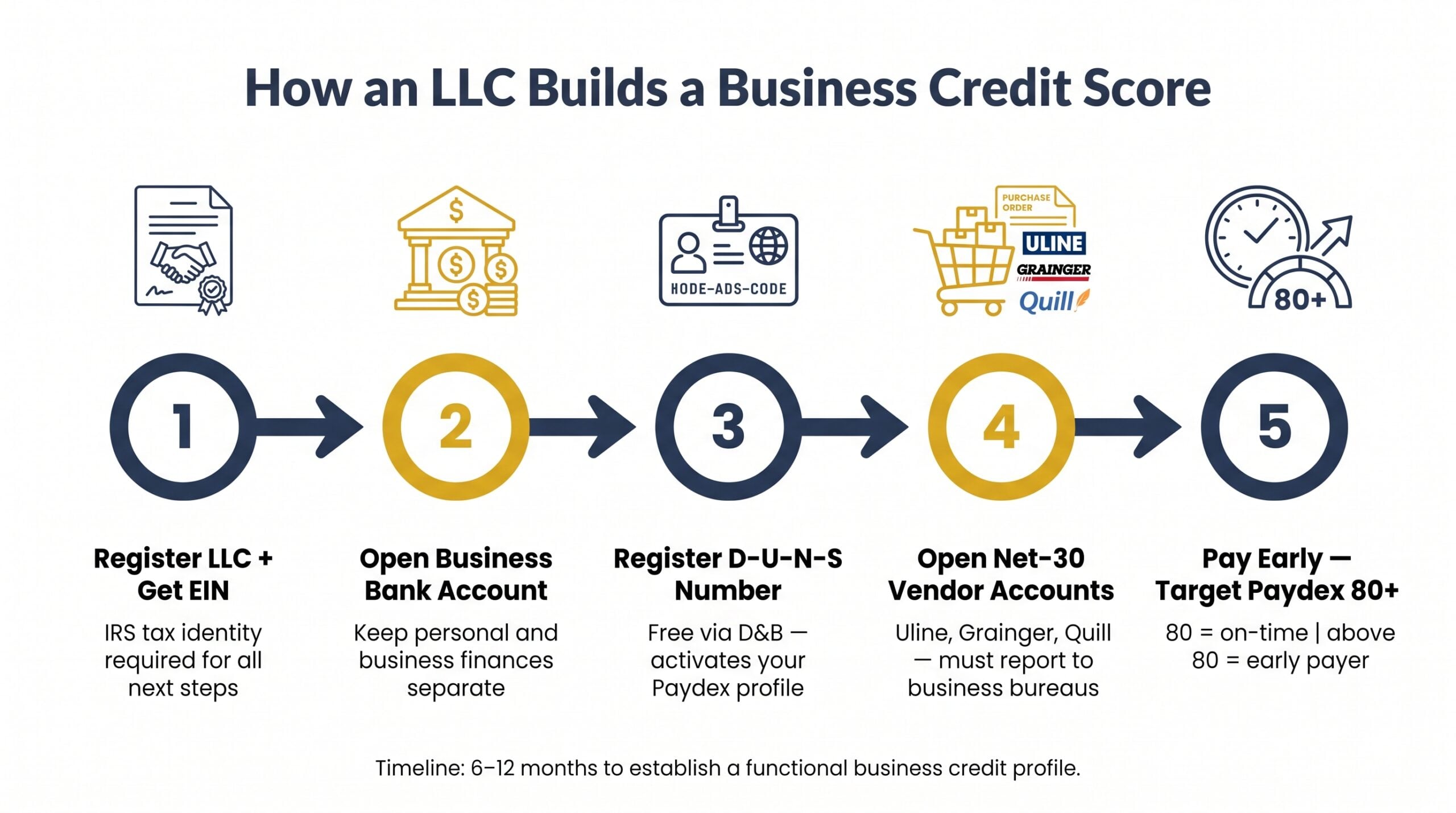
Forming an LLC doesn’t automatically generate a business credit score. Until you build one deliberately, every lender will fall back entirely on your personal FICO.
Here’s the exact sequence to establish business credit from scratch:
- Register your LLC and get an EIN from the IRS. This is your business’s tax identity and a prerequisite for everything that follows.
- Open a dedicated business bank account. Mixing personal and business finances signals immaturity to lenders and complicates your paper trail.
- Register for a D-U-N-S number with Dun & Bradstreet. This is free and activates your business profile in D&B’s system, which generates your Paydex score.
- Open vendor or net-30 accounts that report to business credit bureaus. Uline, Grainger, and Quill are common starting points.
- Pay on time or early. A Paydex of 80 means on-time payment. Above 80 means early. That’s your target for competitive business credit scores.
Most LLCs can establish a functional business credit profile within 6–12 months using this process. Learn how to monitor your progress with our guide on how to check your business credit score for free.
How to Improve Your Credit Score Before Applying
If your score isn’t where it needs to be, waiting and building is often smarter than applying now and paying 30%+ APR. Here’s what actually moves the needle.
For your personal credit score:
- Pay down revolving balances to below 30% utilization. This alone can add 20–40 points within 60 days.
- Dispute errors on your credit report at AnnualCreditReport.com. One in five reports contains a material error.
- Avoid new hard inquiries for at least 6 months before applying.
- Pay every bill on time. Payment history drives 35% of your FICO score; nothing else comes close.
- Keep old accounts open. Closing them shrinks your average account age and can drop your score immediately.
For your business credit score:
- Register your D-U-N-S number and open net-30 vendor accounts that report to D&B.
- Pay all invoices early to push your Paydex score above 80, the threshold most lenders want to see.
Realistic timeline: personal score improvements take 3–6 months of consistent behavior. Building a business credit file from scratch takes 6–12 months. Plan accordingly before your next application.
Pre-Application Readiness Checklist
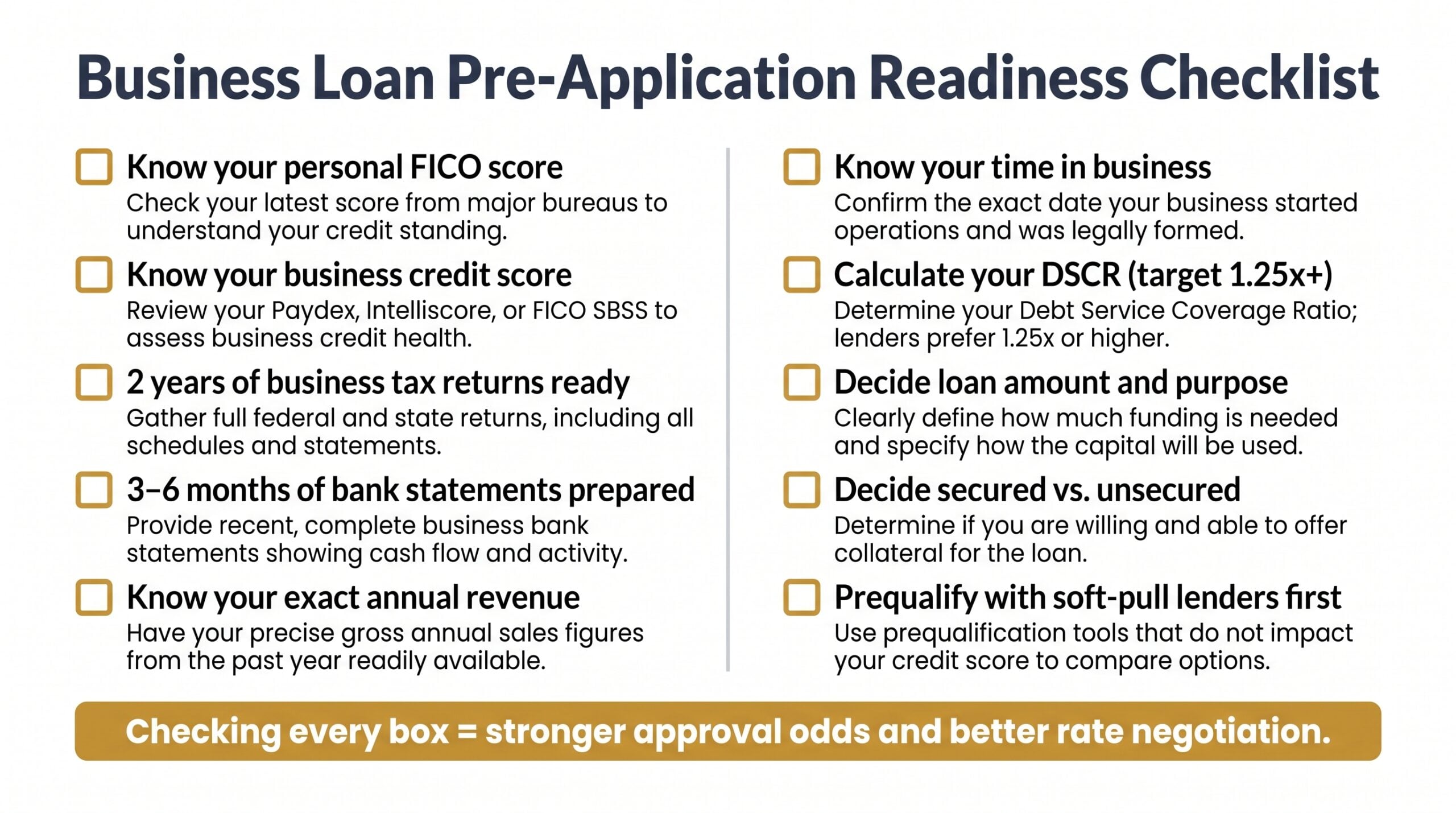
Before you talk to a single lender, run through this list. Knowing where you stand on every item means no surprises, faster approvals, and a stronger negotiating position on rate.
- Know your personal FICO score. Check it free at AnnualCreditReport.com. It’s the number most lenders pull first.
- Know your business credit score. Pull your reports from Experian Business, Equifax Business, and Dun & Bradstreet before any lender does.
- Have 2 years of business tax returns ready. Most banks and SBA lenders require them upfront.
- Have 3–6 months of business bank statements prepared. Cash flow verification is non-negotiable.
- Know your annual revenue. Have the exact figure, not an estimate.
- Know your time in business. It determines which lenders you’re even eligible for.
- Calculate your Debt Service Coverage Ratio. Target 1.25x or higher before applying.
- Decide your loan amount and purpose. Vague requests signal weak planning to underwriters.
- Decide secured vs. unsecured. If your scores are borderline, collateral can tip the decision in your favor.
- Prequalify with soft-pull lenders first. Compare real offers before any hard inquiry touches your report.
If you can check every box confidently, you’re ready to apply. If two or three items give you pause, that’s exactly where to focus the next 60–90 days.
Frequently Asked Questions
What is the minimum credit score to get a business loan?
It depends entirely on the loan type. Alternative lenders and MCAs may approve scores as low as 500. SBA microloans typically require 620+, SBA 7(a) loans need 650+, and traditional banks generally want 680 or higher. Your score sets the ceiling on which products you can access.
Can I get an SBA loan with a 500 credit score?
An SBA 7(a) loan at 500 is extremely unlikely. Some SBA microloan intermediaries work with scores in the low-to-mid 500s, but approval isn’t guaranteed and requirements vary by intermediary. Merchant cash advances, revenue-based financing, and invoice factoring are the realistic paths at that score range.
How much is the monthly payment on a $50,000 business loan?
At 7% APR over 5 years, you’re looking at roughly $990 per month. At 11% APR, that climbs to around $1,087 per month. Your credit score directly determines which rate you qualify for, meaning a stronger score saves you thousands over the loan term.
How does an LLC get a credit score?
It doesn’t happen automatically. An LLC must actively build credit by obtaining an EIN, registering a D-U-N-S number, opening vendor accounts that report to business bureaus, and paying every invoice on time or early. Until those steps are complete, lenders will evaluate the owner’s personal FICO instead.
Ready to find out exactly where you stand? Check your business credit score for free and use the pre-application checklist above before you approach a single lender. Knowing your numbers puts you in control of the conversation, and that’s where better loan terms start.

Founder of Nanotom Capital & Nanotom Labs