Key Takeaways
- Working capital = current assets − current liabilities. A positive number means you can cover short-term obligations; a negative number means liabilities exceed available resources.
- Most lenders want to see a working capital ratio (current ratio) between 1.2 and 2.0. Below 1.0 signals a liquidity problem, above 2.0 suggests idle, undeployed cash.
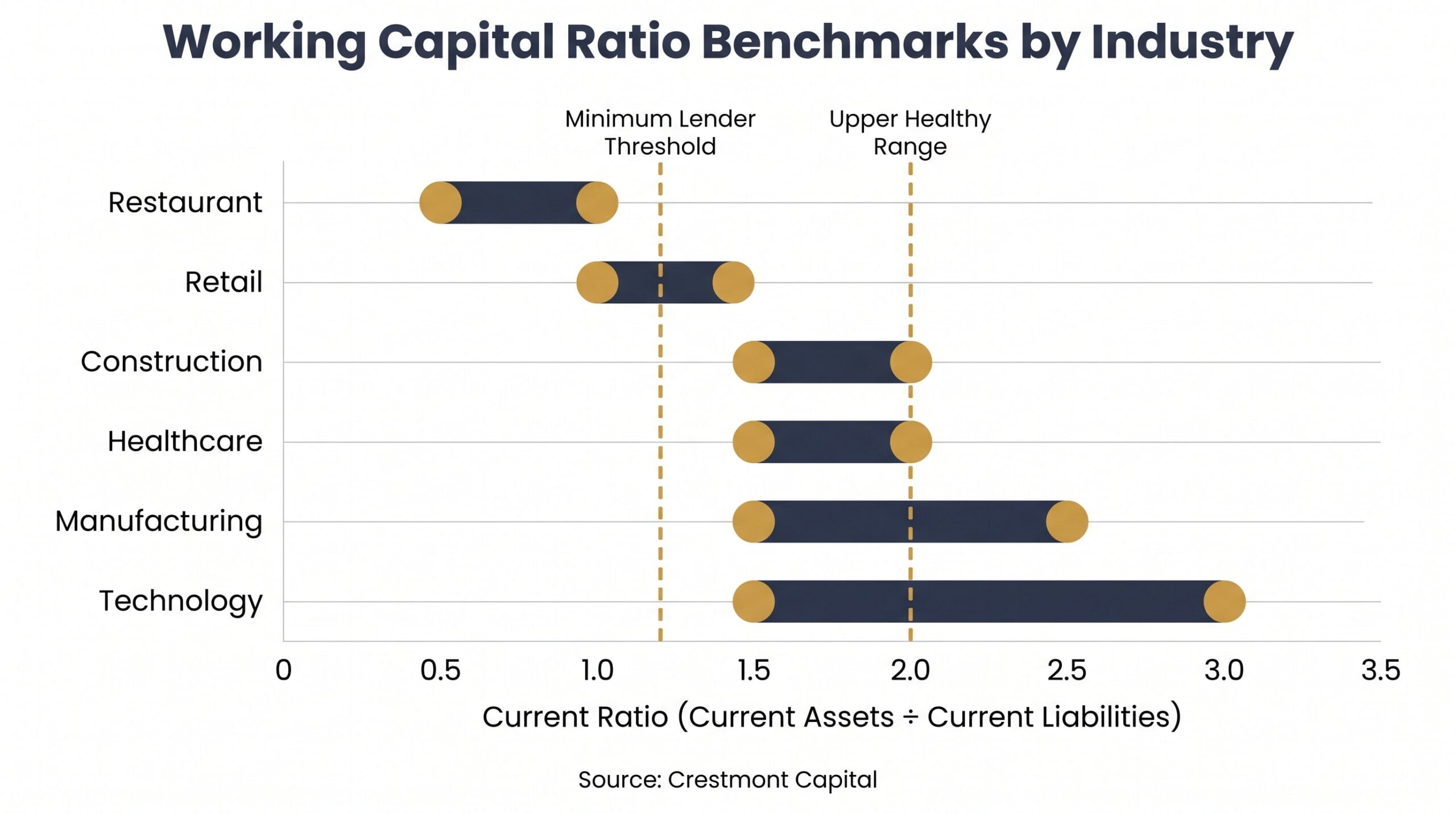
- Industry benchmarks vary widely: restaurants typically run a 0.5–1.0 ratio, while manufacturers and tech companies run 1.5–2.5 and 1.5–3.0, respectively. Compare your number to your industry, not a generic standard.
- KPMG’s 2024 data puts the median Cash Conversion Cycle for small US companies at 120 days, meaning cash can be tied up in operations for four months at a stretch.
- Negative working capital isn’t always a red flag; grocery retailers and subscription businesses run negative by design, collecting cash before supplier bills come due.
- The fastest levers to improve working capital: invoice immediately after delivery, offer 1–2% early-payment discounts, and negotiate 45–60-day payment terms with suppliers.
- Working capital is a static balance-sheet snapshot; cash flow tracks money moving over time. Strong working capital does not guarantee positive cash flow, so you need to monitor both.
Most businesses don’t fail because they’re unprofitable. They fail because they run out of cash to cover next week’s bills. Understanding what is working capital is the fastest way to see exactly where you stand.
This guide gives you the definition, the formula, real numbers, and the benchmarks that actually matter.
What Is Working Capital? (Plain-English Definition)
Working capital is the money your business has left over after you subtract what you owe in the short term from what you own in the short term. The formula is straightforward: Working Capital = Current Assets − Current Liabilities.
That number tells you whether your business can pay its bills and keep operating without borrowing. Think of it like your personal checking account minus the bills due this month. Whatever’s left is your financial breathing room.
So what is working capital in practice? If you have $80,000 in current assets and $50,000 in current liabilities, your working capital is $30,000. You’re solvent. Flip those numbers and you’ve got a serious problem.
At its core, working capital is a real-time snapshot of short-term financial health. Nothing more, nothing less.
The Working Capital Formula
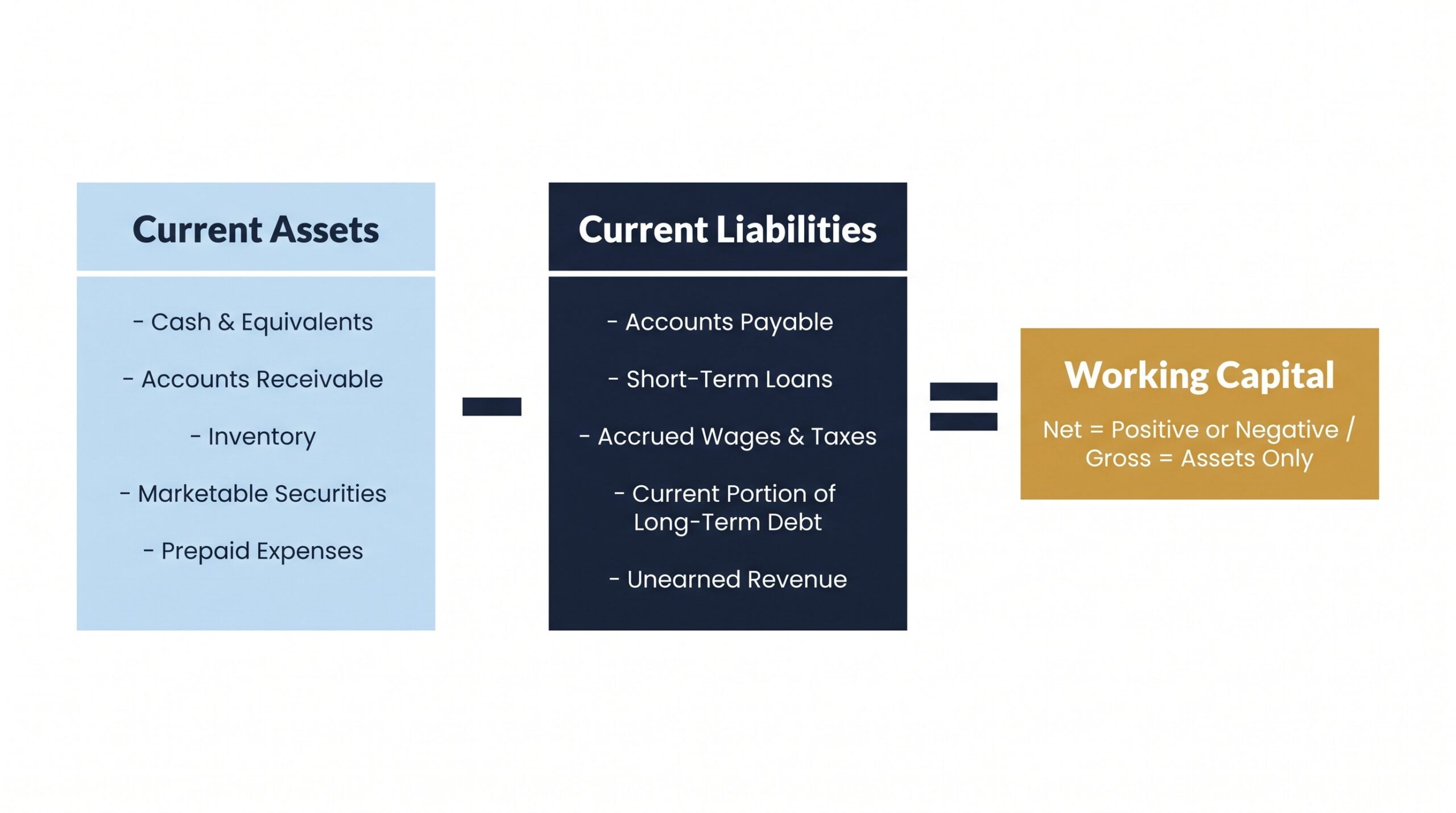
Current assets are resources you’ll convert to cash within 12 months: cash on hand, accounts receivable, and inventory. Current liabilities are obligations due within the same window: accounts payable, short-term loans, and accrued expenses.
You’ll often see “working capital” and “net working capital” used interchangeably, and for most purposes that’s fine; they mean the same thing. If you want to go deeper on the distinction, our net working capital guide covers it in full.
Gross working capital is a different figure entirely. It’s just your total current assets with no liabilities subtracted. It tells you what you have, not what you actually control. For decision-making, net is the number that matters.
What Counts as a Current Asset?
Current assets are everything your business owns or expects to convert to cash within 12 months. These sit on the top half of the working capital equation, and knowing what qualifies matters more than most people realize.
- Cash and cash equivalents: Money in your bank account plus anything that can be liquidated immediately, like Treasury bills.
- Accounts receivable: Invoices you’ve sent that customers haven’t paid yet.
- Inventory: Products you’ve bought or manufactured and are ready to sell.
- Marketable securities: Short-term investments you can sell quickly without significant loss.
- Prepaid expenses: Costs you’ve paid in advance, like a 12-month insurance premium.
What doesn’t count: real estate, equipment, vehicles, and long-term investments. Those are fixed assets. They have value, but you can’t pay Friday’s payroll with a forklift.
What Counts as a Current Liability?
Flip to the other side of the equation. Current liabilities are financial obligations your business must settle within 12 months, the pressure your assets have to absorb.
- Accounts payable: Bills you owe suppliers and vendors that haven’t been paid yet.
- Short-term loans and lines of credit: Borrowed money due within the year, including draws on a revolving credit line.
- Accrued wages and taxes: Payroll earned but not yet paid, plus tax obligations that have accrued.
- Current portion of long-term debt: The slice of a multi-year loan that comes due in the next 12 months.
- Unearned revenue: Customer payments you’ve collected but haven’t delivered the product or service for yet.
Long-term debt beyond the 12-month window stays off this list. It’s real, but it’s not what working capital is concerned with right now. Subtract these from your current assets and you’ve got your number.
How to Calculate Working Capital: A Step-by-Step Example
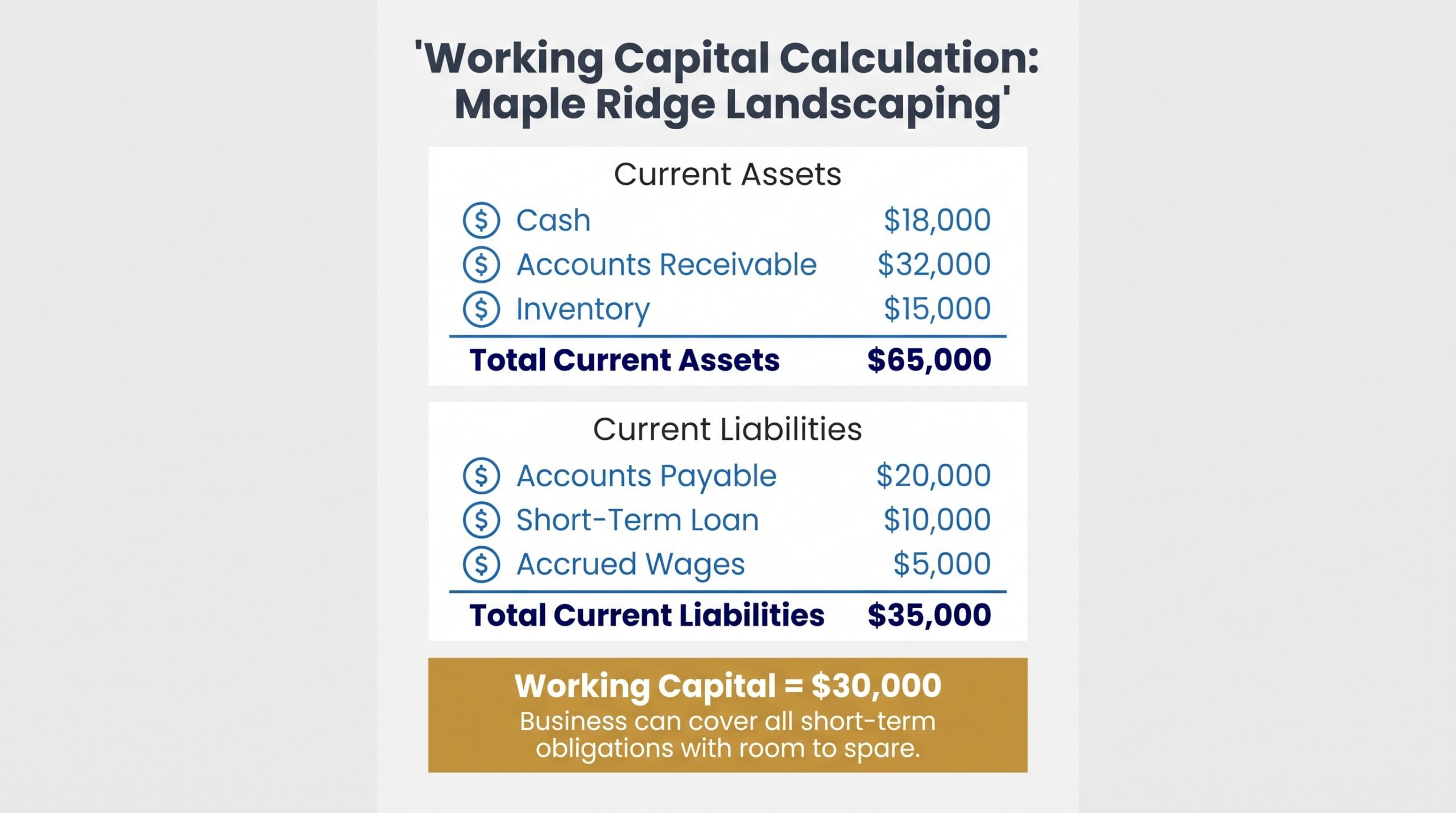
Let’s make this real. Here’s a balance sheet snapshot for a fictional small business, Maple Ridge Landscaping.
| Current Assets | Amount |
|---|---|
| Cash | $18,000 |
| Accounts Receivable | $32,000 |
| Inventory | $15,000 |
| Total Current Assets | $65,000 |
| Accounts Payable | $20,000 |
| Short-Term Loan | $10,000 |
| Accrued Wages | $5,000 |
| Total Current Liabilities | $35,000 |
| Working Capital | $30,000 |
That $30,000 means Maple Ridge can cover every short-term obligation and still have funds left to operate. It’s genuine breathing room, not just a paper profit.
For a deeper walkthrough of the calculation, see our working capital formula guide.
Three Real-World Examples of Working Capital
Here’s what most guides skip: the working capital definition means different things depending on the business you’re running. The same number that looks healthy in one industry can signal trouble in another. These three scenarios show how it plays out.
1. Retail Shop Stocking for the Holidays
Cedar & Co., a gift retailer, carries $120,000 in current assets heading into November, against $60,000 in current liabilities. That $60,000 cushion funds inventory purchases before peak season revenue arrives. Positive working capital here is intentional and necessary.
2. IT Consulting Firm with Lean Assets
Brightline Tech has $85,000 in accounts receivable and minimal inventory, giving it $25,000 in working capital. There’s no warehouse, just unpaid invoices. The risk isn’t stock levels; it’s slow-paying clients.
3. Restaurant Running Slightly Negative
A busy restaurant collects cash daily but pays suppliers on 30-day terms. It can run with slightly negative working capital because cash comes in before bills come due. This is one case where a negative number isn’t a warning sign.
Gross Working Capital vs. Net Working Capital: What’s the Difference?
Most people asking what is working capital actually want net working capital. But the gross version exists, and confusing them causes real mistakes.
| Gross Working Capital | Net Working Capital | |
|---|---|---|
| Formula | Total current assets only | Current assets − current liabilities |
| Can it be negative? | No | Yes |
| Best used for | Measuring total short-term resources | Measuring true short-term financial health |
Gross working capital tells you what you have. Net tells you what you actually control after obligations. For day-to-day decisions, net is the figure that matters.
When lenders, accountants, and investors say “working capital,” they mean net. The Corporate Finance Institute’s breakdown of working capital components covers the distinction in full detail.
What Is a Good Working Capital Number?
The Working Capital Ratio (Current Ratio) Explained
Raw working capital dollars tell you the gap. The working capital ratio tells you the proportion, and that’s often more useful. It’s calculated as current assets divided by current liabilities.
Most lenders want to see it between 1.2 and 2.0. Below 1.0 means liabilities exceed assets. Above 2.0 can signal idle cash sitting undeployed. See our working capital ratio guide for a full breakdown.
Industry Benchmarks: What’s Normal Varies
| Industry | Typical Current Ratio |
|---|---|
| Restaurant | 0.5 – 1.0 |
| Retail | 1.0 – 1.4 |
| Manufacturing | 1.5 – 2.5 |
| Technology | 1.5 – 3.0 |
| Construction | 1.5 – 2.0 |
| Healthcare | 1.5 – 2.0 |
Source: Crestmont Capital’s industry working capital benchmarks. A restaurant running a 0.8 ratio isn’t struggling; a manufacturer at the same number probably is. Compare your ratio to your industry, not a generic standard.
Positive vs. Negative Working Capital: What It Means for Your Business
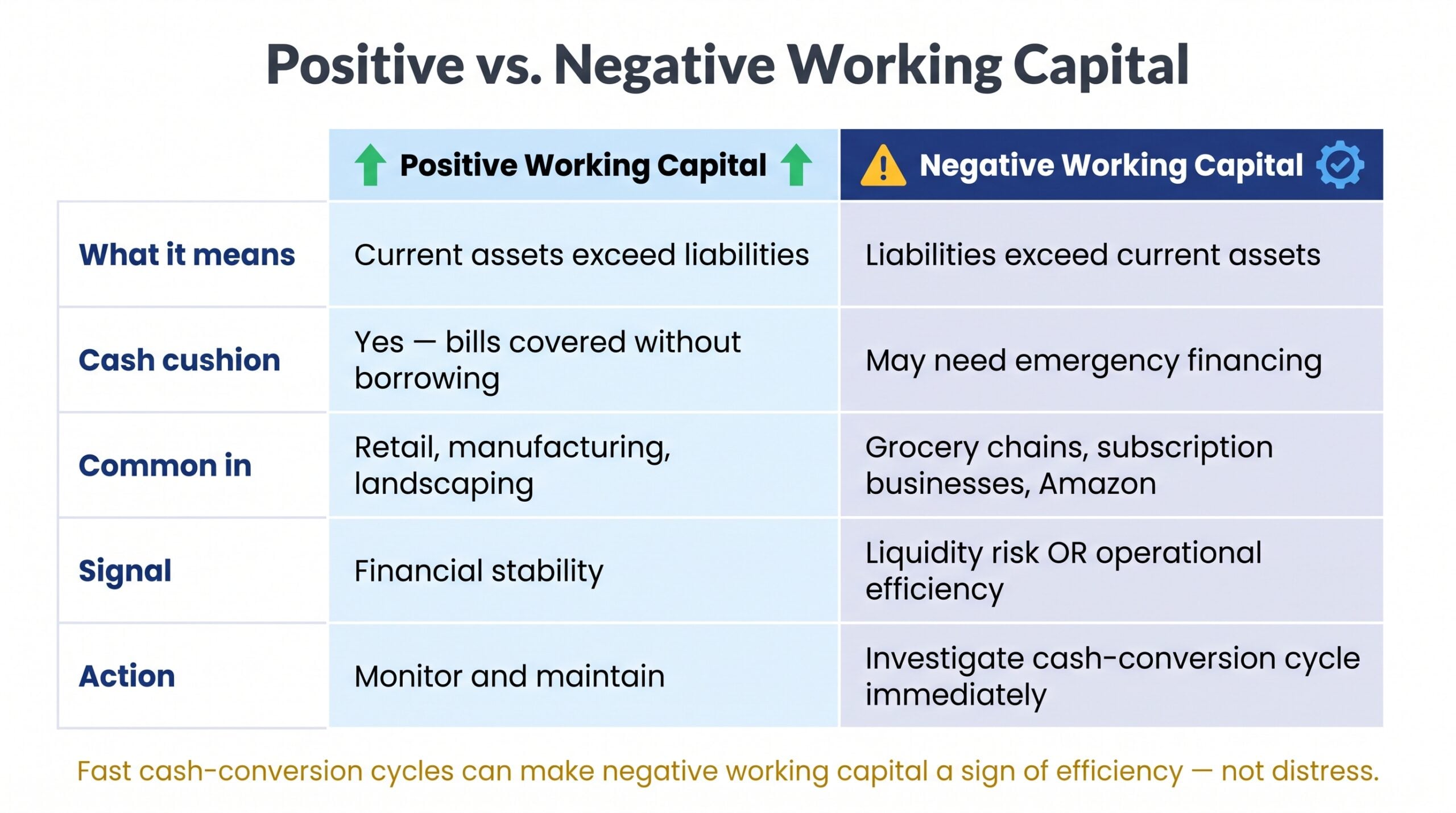
Positive working capital means your current assets exceed your current liabilities. You’ve got a cushion. Bills come due, you cover them, and operations continue without scrambling for cash.
Negative working capital flips that. Liabilities outpace assets, which typically signals a liquidity problem. But not always.
When Negative Working Capital Is Actually Fine
For businesses with fast cash-conversion cycles, negative working capital can signal efficiency, not distress. Grocery retailers collect cash at checkout but pay suppliers 30 days later. Subscription businesses collect annual fees upfront, booking deferred revenue as a liability before delivering the service.
Amazon built much of its early growth model on this exact dynamic, according to Wall Street Prep analysis. The working capital meaning shifts depending on how quickly your business converts operations into cash.
That said, most small businesses aren’t Amazon. Sustained negative working capital without a clear cash-flow advantage is a genuine red flag, and you should address it fast.
Working Capital vs. Cash Flow: Clearing Up the Confusion
These two terms get swapped constantly. They’re related, but they’re not the same thing, and mixing them up leads to real blind spots.
| Working Capital | Cash Flow | |
|---|---|---|
| What it is | A snapshot in time | Movement of money over time |
| Found on | Balance sheet | Cash flow statement |
| Nature | Static | Dynamic |
Think of it this way: working capital is the water level in your tank. Cash flow is how fast water flows in and out. You can have a high water level and still run dry if the outflow is faster than the inflow, as Chase Business notes.
Strong working capital doesn’t guarantee positive cash flow. Track both, and if you want to understand how your working capital position shifts from period to period, our guide on change in net working capital explains how to read that movement over time.
Why Working Capital Matters for Your Business
The honest answer is that most owners don’t think about working capital until there’s a problem, and by then, options are limited. Here’s why staying on top of it before a crisis matters.
- Liquidity: It’s your first line of defense when bills arrive. No cushion means scrambling for cash on deadline.
- Operational continuity: Payroll, rent, and supplier invoices don’t wait for your customers to pay. Working capital bridges that gap.
- Financial flexibility: A healthy buffer lets you act on bulk-purchase discounts or unexpected growth opportunities without taking on emergency debt.
- Creditworthiness: Lenders check your working capital ratio before approving loans. Low numbers mean higher rates or outright rejection.
- Seasonal resilience: Cyclical businesses need reserves before peak-season revenue arrives.
KPMG’s 2024 US Working Capital Trends data puts the median Cash Conversion Cycle for small US companies at 120 days. That’s four months with cash tied up in operations. At that scale, working capital management isn’t optional; it’s survival. See our working capital management guide for practical strategies.
How to Improve Your Working Capital
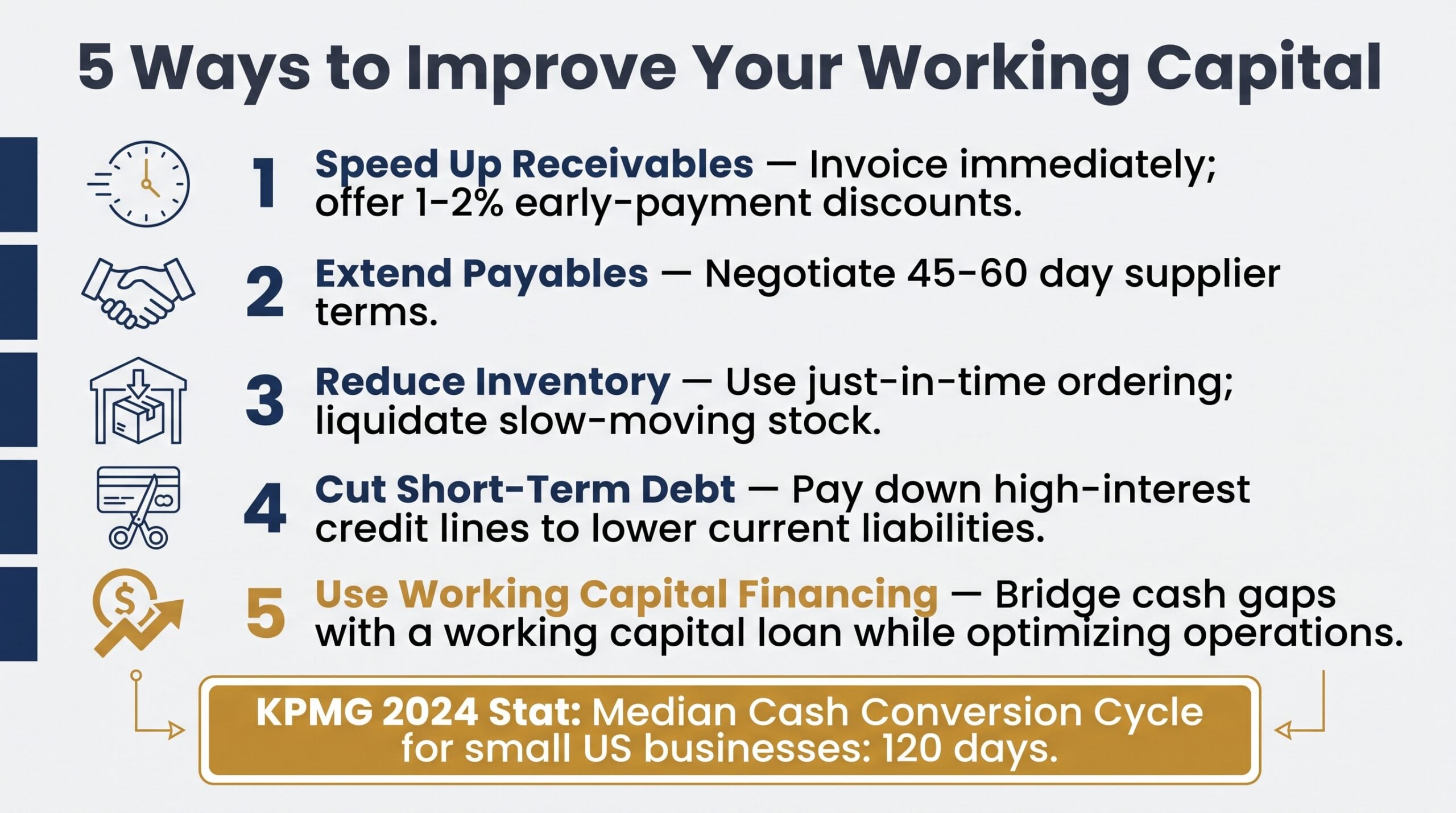
Knowing what working capital means is step one. Step two is doing something about it. Here are five levers you can pull today. Some of them faster than you might expect.
- Speed up receivables. Invoice immediately after delivery. Offer a 1–2% early-payment discount to clients who settle within 10 days instead of 30.
- Extend payables. Negotiate 45 or 60-day terms with suppliers. You’re not paying late; you’re paying smarter.
- Reduce inventory. Adopt just-in-time ordering where possible. Liquidate slow-moving stock, even at a discount, to free up tied cash.
- Cut short-term debt. High-interest credit lines inflate your current liabilities. Paying them down directly improves your working capital position.
- Use working capital financing. Sometimes the gap is too wide to close through operations alone. A working capital loan bridges the shortfall while you optimize, and SBA working capital loans offer lower-cost options for qualifying businesses.
Working Capital FAQs
What is working capital in simple words?
Working capital is the money your business has left over to run day-to-day operations after covering short-term debts. It’s current assets minus current liabilities.
What are three examples of working capital?
Cash in your checking account, unpaid customer invoices (accounts receivable), and inventory on your shelves are all working capital components. Subtract what you owe short-term, and you’ve got your net figure.
What is working capital for dummies?
Think of it as your business’s financial breathing room. If you have $80,000 in assets and $50,000 in bills due soon, your working capital is $30,000.
How do I calculate working capital?
Subtract your total current liabilities from your total current assets. That’s it. A positive number means you’re covered. A negative number means short-term debts exceed available resources.
What is the difference between working capital and cash flow?
Working capital is a static snapshot of your financial position today. Cash flow tracks money moving in and out over time. You need both to run a healthy business.
Is negative working capital always bad?
Not always. Grocery chains and subscription businesses often run negative working capital by design, collecting cash before paying suppliers. For most small businesses, though, sustained negative working capital signals a serious liquidity problem.
If your working capital is consistently tight, you don’t have to figure it out alone. Nanotom Capital specializes in fast, flexible working capital loans built for small businesses that need to close the gap now, not next quarter. Apply today and get a decision without the wait.

Founder of Nanotom Capital & Nanotom Labs