Key Takeaways
- 80% of small business owners either don’t have a business credit score or aren’t aware of it; a direct barrier to accessing capital.
- Business credit reports are public record: vendors, landlords, and competitors can pull your report without your permission; no consent required.
- Three separate bureaus score your business independently: D&B PAYDEX (1–100), Experian Intelliscore Plus (1–100), and Equifax Delinquency Score (224–580), and your numbers won’t match across all three.
- A PAYDEX score of 80 means on-time payment; anything below 80 signals late payments to lenders. Target 80 as your floor, not your goal.
- Forming an LLC does not automatically create a business credit score; a profile only exists once you open reporting tradelines and maintain consistent payment history.
- Expect 6–12 months of on-time payments across multiple reporting accounts before your score carries real weight with lenders.
- Personal credit still dominates for loans under roughly $250K; most lenders require a personal guarantee at that level regardless of your business credit profile.
Most business owners apply for funding and get rejected without knowing why. Understanding how business credit works gives you the leverage to fix the problem before it costs you capital. This guide breaks down exactly how business credit scores work, which bureaus track them, and how to build a score that gets you approved. Whether you’re running an LLC or a sole proprietorship, this is your roadmap.
Do Businesses Have Credit Scores?
Yes, but only if credit-reporting activity has been initiated on that business. A brand-new company starts with zero credit history and no score by default. Nothing gets reported automatically just because you registered your LLC or opened a business bank account.
The mechanics differ significantly from personal credit. Here’s what most guides skip: business credit reports are largely public record. Anyone can pull them: your vendors, landlords, even your competitors. Personal credit reports require your consent. Business reports don’t.
That gap matters more than most people realize. According to data from Nav, roughly 80% of small business owners either don’t have a business credit score or aren’t aware of it. That’s a serious blind spot when you’re trying to access funding.
And yes, businesses have credit scores across multiple bureaus, each using a different scoring model. We’ll break all of them down in the next section.
What Is a Business Credit Score?
A business credit score is a numerical rating that reflects how reliably your company pays its debts. Lenders, vendors, and suppliers use it to decide whether to extend credit, and on what terms. It’s tied to your business, not your Social Security Number.
Who Creates Business Credit Scores?
Three major bureaus generate business credit scores independently:
- Dun & Bradstreet produces the PAYDEX score (0–100). You need a D-U-N-S number first. It’s free at dnb.com, but standard processing takes up to 30 business days.
- Experian Business produces the Intelliscore Plus (0–100).
- Equifax Business produces the Delinquency Score, along with a few additional risk ratings.
Each bureau scores independently, so your numbers won’t be identical across all three.
What Goes Into a Business Credit Score?
Payment history carries the most weight. Beyond that, bureaus factor in credit utilization, years in business, company size, number of active tradelines, and public records like liens, judgments, or bankruptcies.
The primary data feeders are vendors and suppliers who report your net-30 account payments. No reporting means no score, regardless of how long you’ve been in business.
Business Credit Score Ranges: What the Numbers Actually Mean
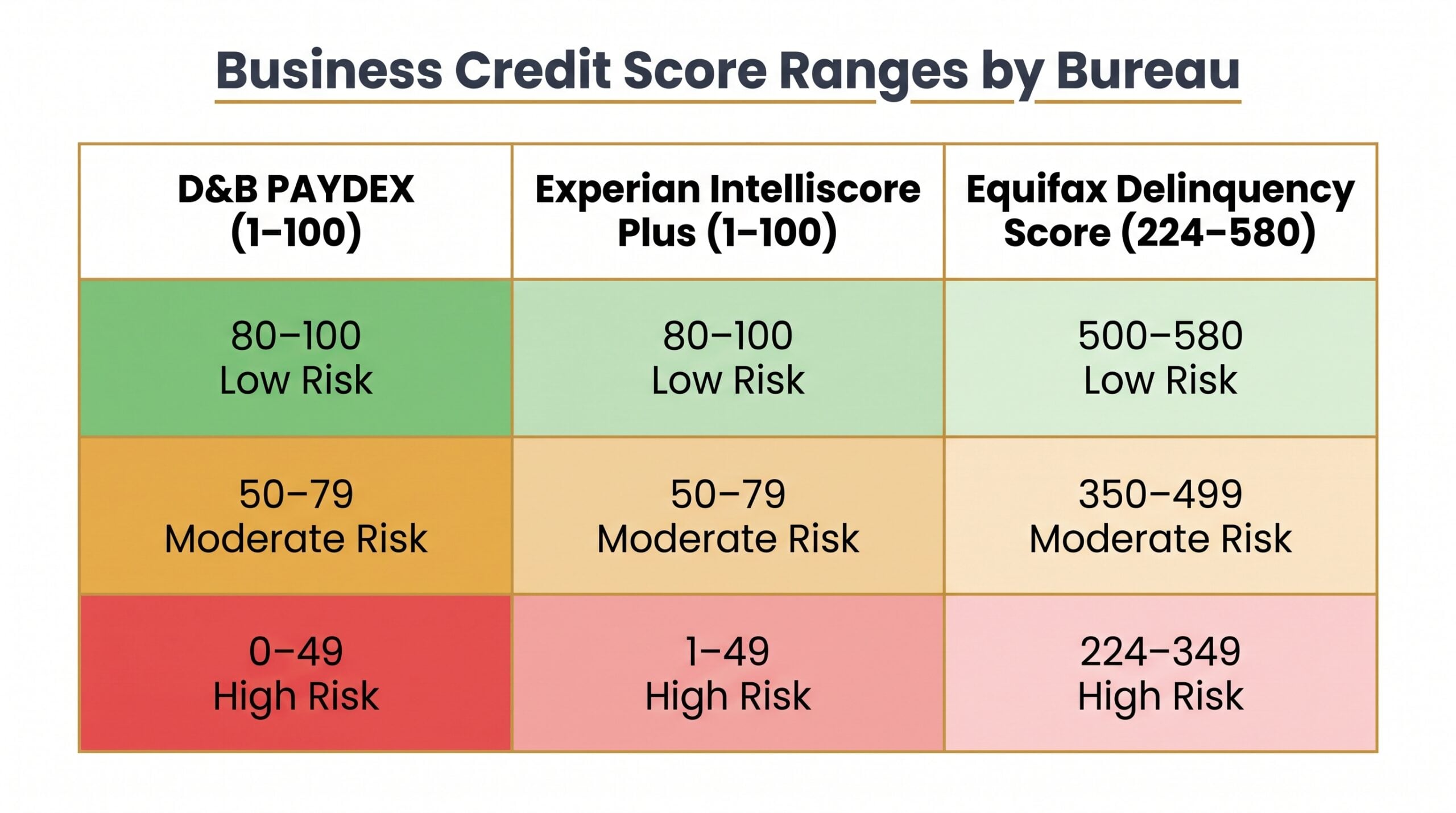
Three bureaus, three different scales. They don’t line up neatly, and confusing them is an easy mistake that costs businesses real money. Here’s exactly what each number means in practice.
Dun & Bradstreet PAYDEX Score (1–100)
80 means you’re paying exactly on time. 100 means you’re paying 30+ days early. Drop below 80 and lenders start getting nervous.
According to Dun & Bradstreet’s PAYDEX scoring model, a 72 PAYDEX score is NOT good, despite feeling close. It sits in the moderate-risk band and signals payments arriving 1–30 days late. Target 80 as your floor, not your goal.
Experian Intelliscore Plus (1–100)
80–100 is low risk. 50–79 is medium risk. Anything below 50 puts you in high-risk territory, where approvals dry up fast and terms get expensive.
Equifax Business Delinquency Score (224–580)
Equifax runs its scale in reverse from what most people expect. 580 is the best possible score. 224 is the highest risk. Don’t confuse a “low” Equifax number with a good outcome; it works the opposite way.
| Bureau | Score Range | Low Risk | Moderate Risk | High Risk |
|---|---|---|---|---|
| D&B PAYDEX | 1–100 | 80–100 | 50–79 | 0–49 |
| Experian Intelliscore Plus | 1–100 | 80–100 | 50–79 | 1–49 |
| Equifax Delinquency Score | 224–580 | 500–580 | 350–499 | 224–349 |
Business Credit vs. Personal Credit: Key Differences
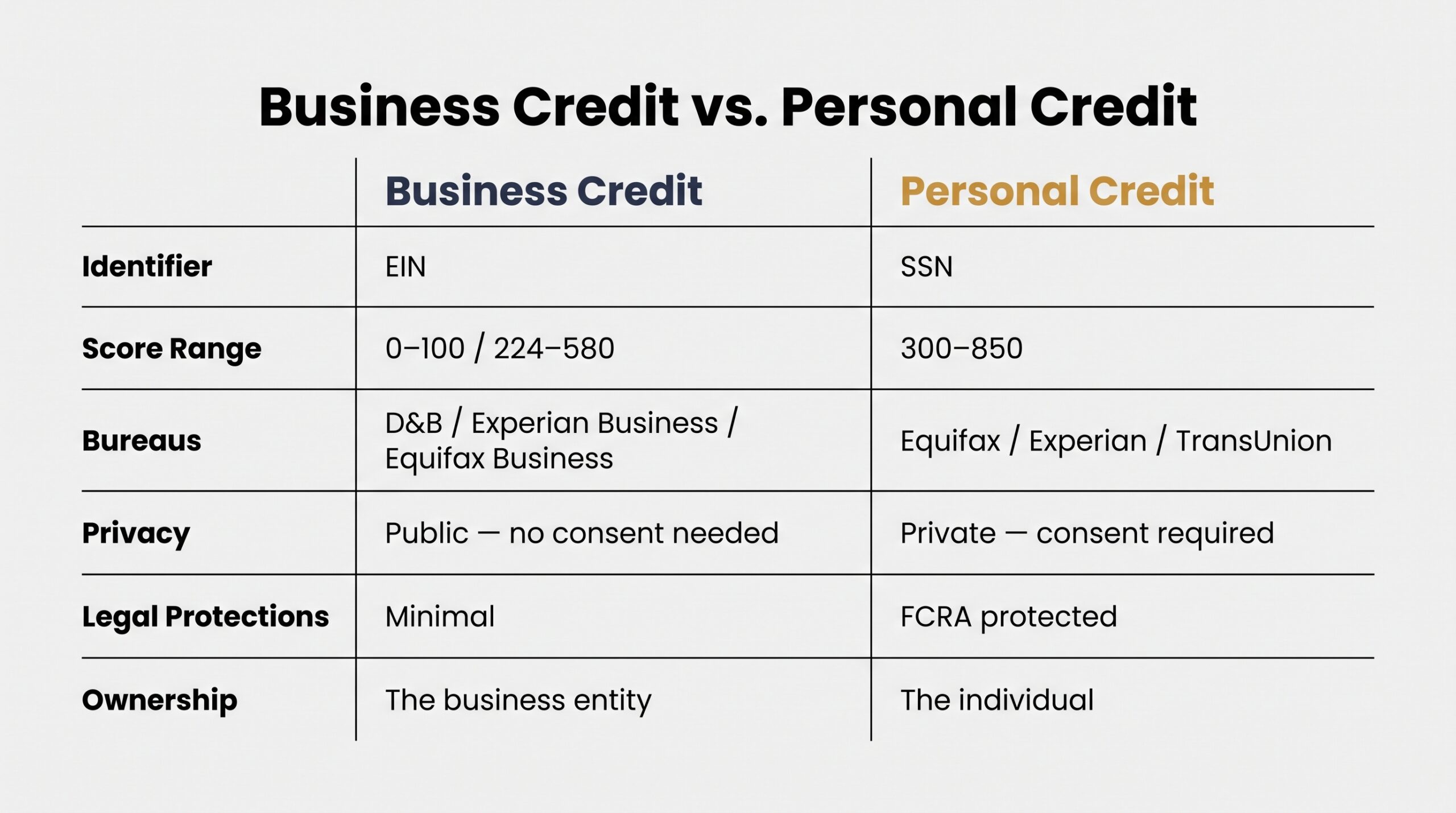
The honest answer is that most business owners treat these two things as interchangeable, and that mistake follows them into every loan conversation they’ll ever have. They’re not the same, and the differences are worth knowing cold.
| Factor | Business Credit | Personal Credit |
|---|---|---|
| Identifier | EIN (Employer Identification Number) | SSN (Social Security Number) |
| Score Range | 0–100 (D&B, Experian) / 224–580 (Equifax) | 300–850 |
| Bureaus | D&B, Experian Business, Equifax Business | Equifax, Experian, TransUnion |
| Privacy | Public; anyone can access it | Private; requires your consent |
| Legal Protections | Minimal | FCRA protections apply |
| Who Owns It | The business entity | The individual |
That public accessibility point deserves a second look. Your vendors, your landlords, and yes, your competitors can pull your business credit report without asking you first. That’s simply not how personal credit works.
Separating your EIN from your SSN also matters for liability. When your business credit stands on its own, lenders have less reason to reach into your personal finances to make a decision.
That said, personal credit still dominates for loans under roughly $250K. Most lenders require a personal guarantee at that level regardless of how strong your business profile looks. See exactly what credit score you need for a business loan to understand where each type of credit carries the most weight.
Does an LLC Have a Business Credit Score?
Not automatically, and this is where a lot of business owners waste months assuming their work is done.
Forming an LLC gives you a legal entity, not a credit profile. Your LLC starts with zero credit history and no score until you initiate reportable credit activity. A score only develops once your LLC has tradelines being reported to the bureaus, things like net-30 vendor accounts, business credit cards, or loans that report to D&B, Experian Business, or Equifax Business.
LLCs do have a real structural advantage over sole proprietorships here. A sole proprietor’s business credit is legally tangled with their personal credit. An LLC’s credit profile is separate by design, and that separation protects your personal assets while keeping a business default from wrecking your personal FICO score.
Realistically, expect 6–12 months of consistent, on-time payments before your LLC builds a score meaningful enough to influence lender decisions. That timeline shortens if you open multiple reporting tradelines early and pay ahead of due dates rather than just on time. The structure is there. You have to activate it.
Can Anyone Check a Company’s Business Credit Score?
Yes; and most business owners don’t realize this until it’s already working against them.
Unlike personal credit, business credit reports are public record. No permission required. A vendor deciding whether to extend you net-60 terms, a competitor sizing up your financial health, or an investor running due diligence can all pull your business credit report without telling you.
A weak score doesn’t just hurt loan applications. It affects vendor relationships, contract negotiations, and partnership opportunities before you even get to the table. You can lose deals you’ll never know you were being considered for.
Here’s where to access business credit reports:
- Capital One Business CreditWise: Free, unlimited checks, no account required
- Nav: Free summary scores from multiple bureaus
- CreditSafe: Free initial report, good for quick vendor checks
- Experian Business: Paid, most comprehensive Intelliscore Plus detail
- D&B CreditSignal: Free PAYDEX change alerts for your own profile
Monitor your own score at least quarterly. If you don’t know what’s on your report, everyone else checking it knows more about your business than you do.
How to Check Your Own Business Credit Score
There’s no AnnualCreditReport.com equivalent for businesses. No federal law mandates a free annual business credit report, so you have to be intentional about monitoring yours. Here’s a simple three-step approach:
- Identify which bureaus have a file on you. If you’ve never initiated credit activity, you may not have a profile at all. Start with Nav or CreditSafe to find out where you exist and where you don’t.
- Use free platforms for summary-level data. Nav gives you a snapshot across multiple bureaus at no cost. CreditSafe offers a free initial report. These won’t show every tradeline, but they’ll confirm whether your business entity has a score attached to it.
- Pull a full paid report for comprehensive detail. D&B, Experian Business, and Equifax Business all offer detailed reports for a fee. If you’re preparing for a loan application or major vendor contract, a full report is worth it.
Knowing your score exists is one thing. Knowing exactly what’s on it before a lender sees it is how you stay in control of the conversation.
See our full guide on how to check your business credit score for free for a platform-by-platform breakdown.
How to Build Business Credit from Scratch
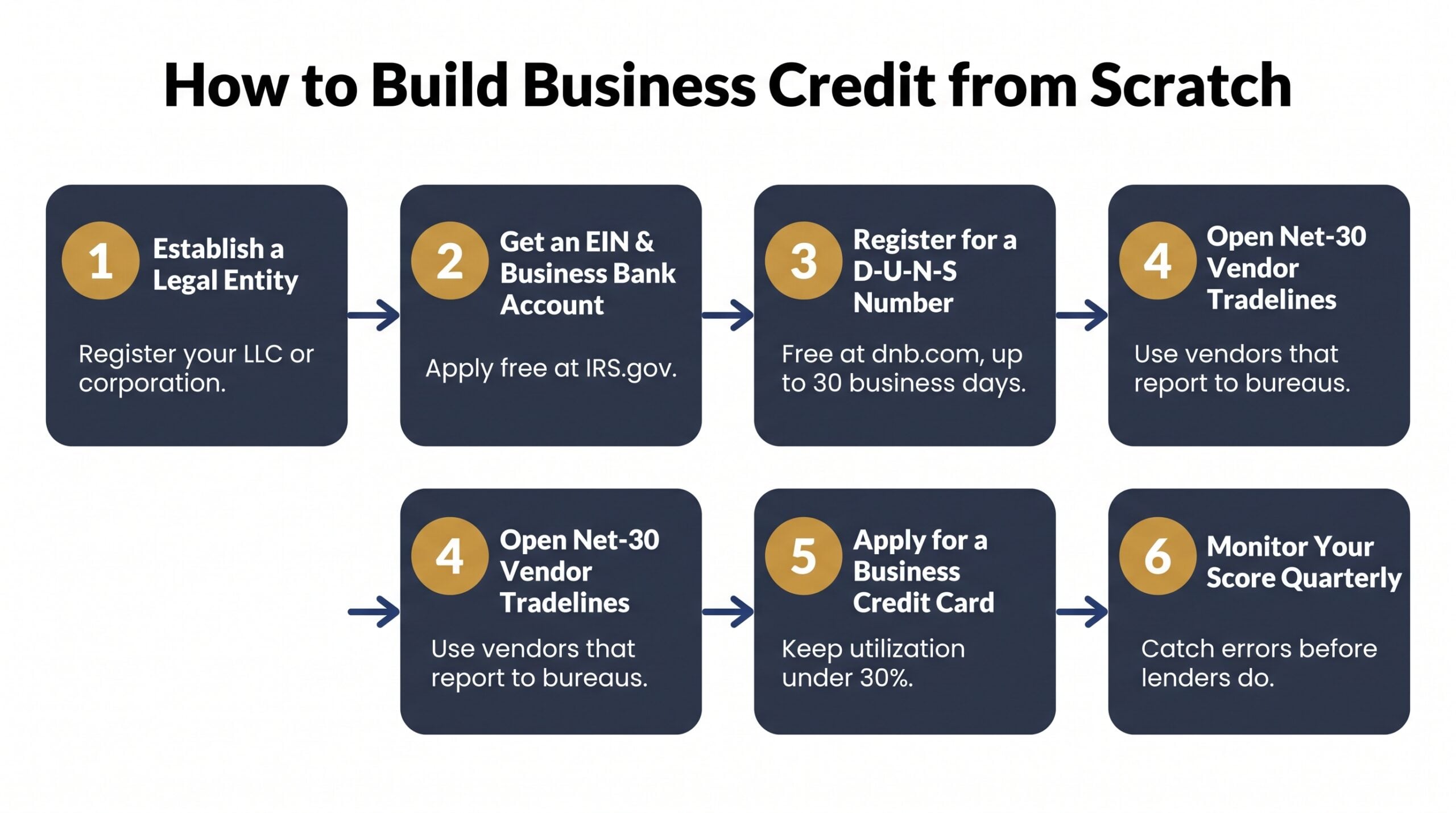
Whether you’re a new LLC or an established business that never prioritized credit, the path is the same. Follow these steps in order.
Step 1: Establish Your Business as a Legal Entity
Register your LLC or corporation with your state. Credit bureaus track legal entities, not informal operations. A sole proprietorship without a formal structure can’t build a credit profile separate from yours.
Step 2: Get an EIN and Open a Business Bank Account
Apply for an EIN at IRS.gov; it’s free. Then open a dedicated business bank account. This separates your finances and signals legitimacy to lenders and vendors who’ll be evaluating you down the road.
Step 3: Register for a D-U-N-S Number
Apply at dnb.com at no cost. Standard processing takes up to 30 business days, so do this early. Without a D-U-N-S number, D&B can’t score you, full stop.
Step 4: Open Vendor Tradelines (Net-30 Accounts)
Open accounts with vendors who report payment activity to the bureaus. Not all vendors do. Uline, Quill, and Grainger are commonly cited starters that report to D&B. Pay early, every time; on time is the floor, not the goal.
Step 5: Apply for a Business Credit Card
Choose a card that reports to business bureaus, not just personal ones. Keep utilization under 30%. This adds another active tradeline and diversifies your credit mix.
Step 6: Monitor and Maintain Your Score
Check your reports quarterly. The mistakes that kill scores fastest are paying late, carrying high utilization, using inconsistent business name or address across bureaus, relying on vendors that don’t report, and applying for too much credit at once.
Use this guide to check your business credit score for free so you catch problems before lenders do.
Why Your Business Credit Score Matters for Funding
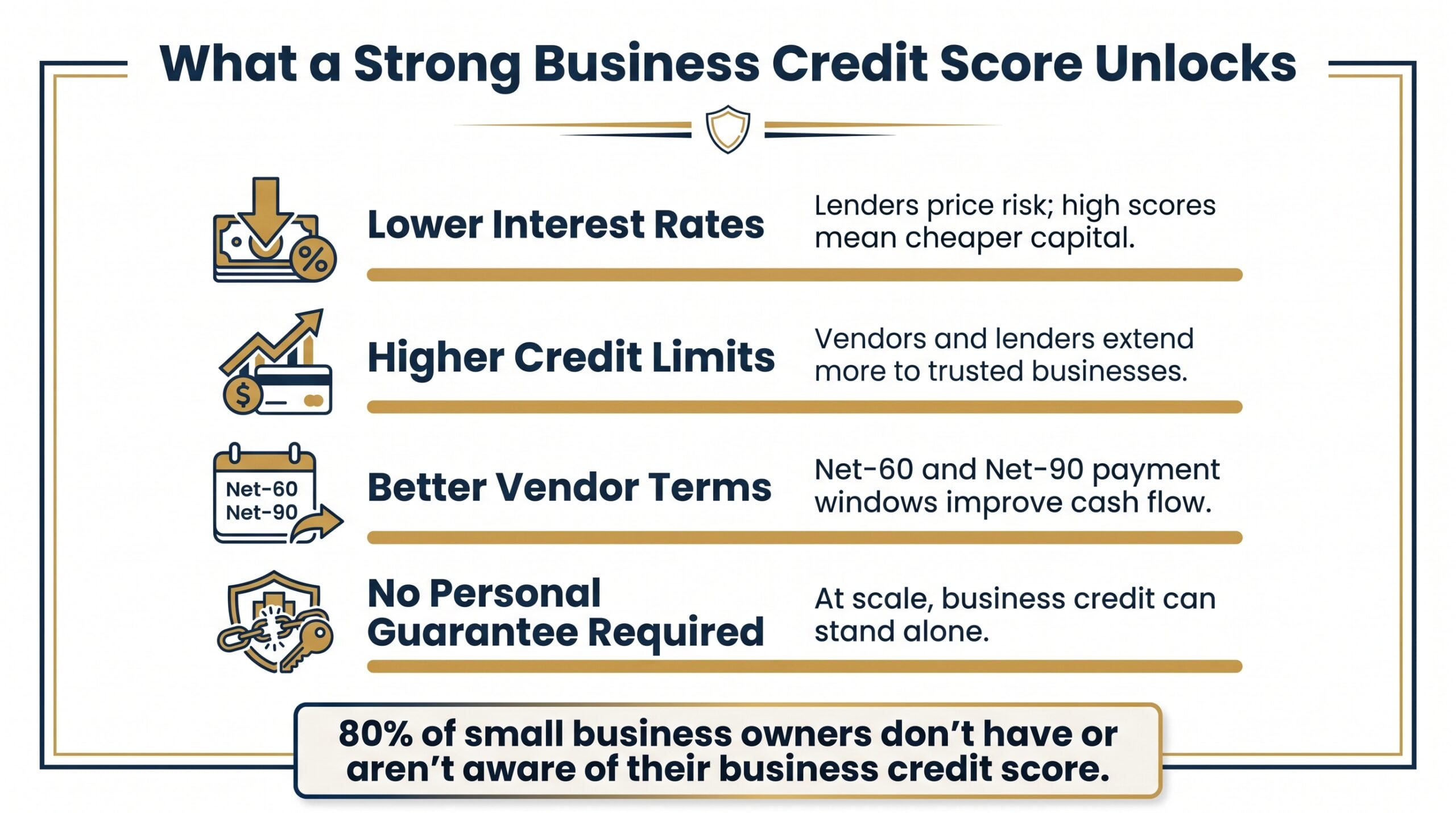
A strong business credit score isn’t a vanity metric. It directly determines the terms you’ll qualify for, how much you can borrow, and whether you’ll need to put your personal assets on the line to get it.
Here’s what a lender-ready score unlocks:
- Lower interest rates: Lenders price risk. A high score means cheaper capital.
- Higher credit limits: Vendors and lenders extend more to businesses they trust.
- Net-60 and net-90 vendor terms: Better cash flow management without touching a credit line.
- Financing without a personal guarantee: At scale, a strong business profile can stand on its own.
Lenders aren’t the only ones running checks. Vendors assess payment risk before extending terms. Insurers factor credit into commercial policy pricing. Prospective partners run checks before signing contracts. A weak score costs you deals you’ll never even know you lost, because your report was pulled before you ever got on a call.
Before applying for any business funding, know exactly where your credit stands. See what credit score you need for a business loan to understand the thresholds that actually matter to lenders.
Frequently Asked Questions
Do all businesses have a credit score?
No. A profile only exists once reportable credit activity, such as vendor tradelines or business loans, is established and reported to a bureau like D&B, Experian Business, or Equifax Business. Many small businesses operate for years with no score at all.
Is 72 a good business credit score?
On the D&B PAYDEX scale, 72 is above average but not ideal. Most lenders prefer 75 or higher, and a score of 80+ signals low risk. On Experian’s Intelliscore Plus, 72 out of 100 puts you in the low-risk tier and is generally considered strong.
How can I see my LLC credit score?
Start with Nav or CreditSafe for a free summary. For a full report, purchase directly from D&B, Experian Business, or Equifax Business. There’s no federally mandated free annual report for businesses the way there is for personal credit.
Can I check the credit score of a company?
Yes. Business credit reports are public record. Anyone can pull a company’s report without the business owner’s permission using tools like Nav, CreditSafe, or Experian Business.
Does opening an LLC automatically create a business credit score?
No. Forming an LLC creates a legal entity, not a credit profile. A score only develops once the LLC opens reporting tradelines and maintains a consistent payment history.
How long does it take to build a business credit score?
Expect 6–12 months of consistent, on-time payments across multiple reporting tradelines before your score carries real weight with lenders. Opening more reporting accounts early compresses that timeline.
If you’re ready to put your business credit to work, start by knowing exactly where you stand. Check what score you need to qualify for a business loan, then contact Nanotom Capital to explore funding options built around your business’s actual credit profile, not just your personal finances.

Founder of Nanotom Capital & Nanotom Labs