Key Takeaways
- 45% of small business loan applications are rejected solely due to credit score; a fixable number problem, not a business model problem.
- Four scoring models matter (Experian Intelliscore Plus, D&B PAYDEX, Equifax’s three models, and FICO SBSS), and each lender may pull a different one; monitoring just one bureau leaves you exposed.
- SBA 7(a) lenders use the FICO SBSS (0–300 scale), with a minimum of 165 and a preferred threshold of 180+, a score you can’t check for free anywhere.
- Business credit is public record; competitors, vendors, and lenders can pull your report right now without your knowledge or consent.
- On D&B PAYDEX, paying on time only gets you to 80; paying early is what pushes your score toward 100 and separates you from competing applicants.
- Nav, D&B Credit Insights, and OnDeck all offer free score access with no credit card required; a full multi-bureau overview takes under 10 minutes to pull.
- Free scores are directionally accurate: if your score looks weak on a free tool, it looks weak to lenders too; use them to catch problems before a lender does.
Most business owners don’t know their business credit score exists until a lender declines them. That’s a painful way to find out. Free business credit scores are widely available, and checking them takes less than five minutes. This guide breaks down every bureau, every free tool, and exactly what each one shows you, so you can walk into a funding conversation prepared.
What Is a Business Credit Score?
A business credit score is a numerical rating that reflects how reliably your company pays its debts, typically ranging from 0 to 100 depending on the bureau. Unlike your personal credit score, business credit is public record. Any lender, supplier, or competitor can pull your business credit profile without your permission.
That visibility cuts both ways. Build it well, and it works for you. Ignore it, and it works against you, quietly, and usually at the worst possible moment.
Only 12% of small businesses rely solely on business credit when applying for financing, according to the Federal Reserve’s 2024 Small Business Credit Survey. That means the overwhelming majority of owners are missing a real credit-building lane. If you’re not sure where your business stands, understanding how business credit works vs. personal credit is the right starting point before you chase free business credit scores from any bureau.
Why Your Business Credit Score Matters
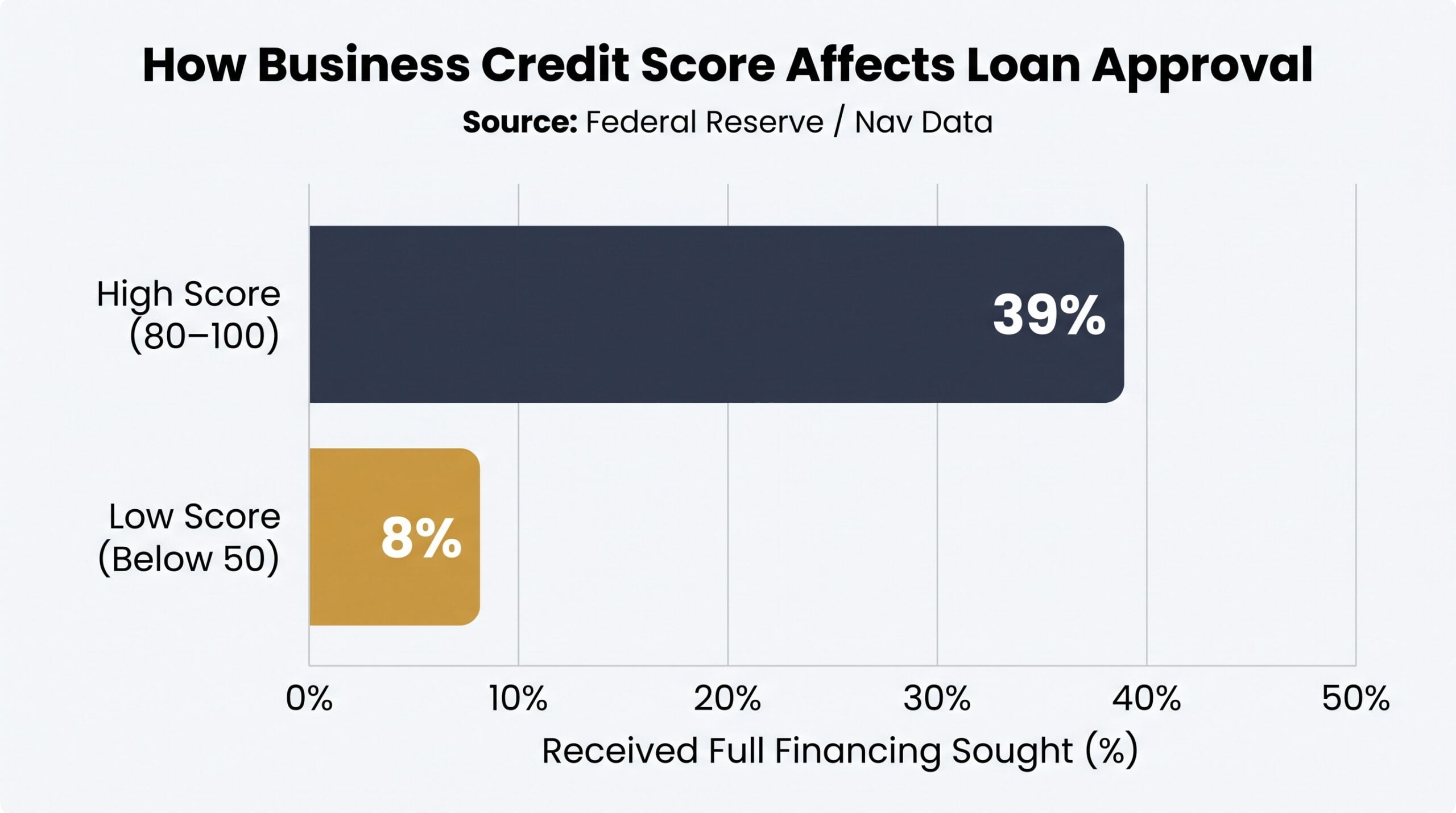
According to Nav’s small business credit statistics, 45% of small business borrowers get rejected solely because of their credit score. That’s not a cash flow problem or a business model problem. It’s a number problem, and it’s one you can fix once you know it.
Impact on Loan Approval
Companies scoring 80–100 received all the financing they sought 39% of the time. Poor-scoring companies? Just 8%.
Most lenders set a hard floor around 75. Below that, you’re not negotiating terms; you’re getting declined.
Impact on Interest Rates and Terms
A stronger score doesn’t just get you approved. It gets you better rates, longer repayment windows, and higher credit limits.
The difference between a 70 and an 85 can translate to thousands in annual interest costs. That’s real money leaving your business every year because of a number you might not even be tracking.
Impact Beyond Financing (Vendors, Insurance)
Suppliers use your score to decide whether to extend net-30 or net-60 terms. Insurers use it to set premiums. Your score affects nearly every major business relationship, not just the ones involving a bank.
| Factor | Low Score (Below 50) | High Score (80–100) |
|---|---|---|
| Loan Approval Rate | 8% | 39% |
| Interest Rates | Higher, often significantly | Competitive rates |
| Vendor Terms | Prepay or COD required | Net-30/60 available |
| Insurance Premiums | Elevated premiums | Standard or lower rates |
The 3 Major Business Credit Bureaus (And Their Scoring Models)
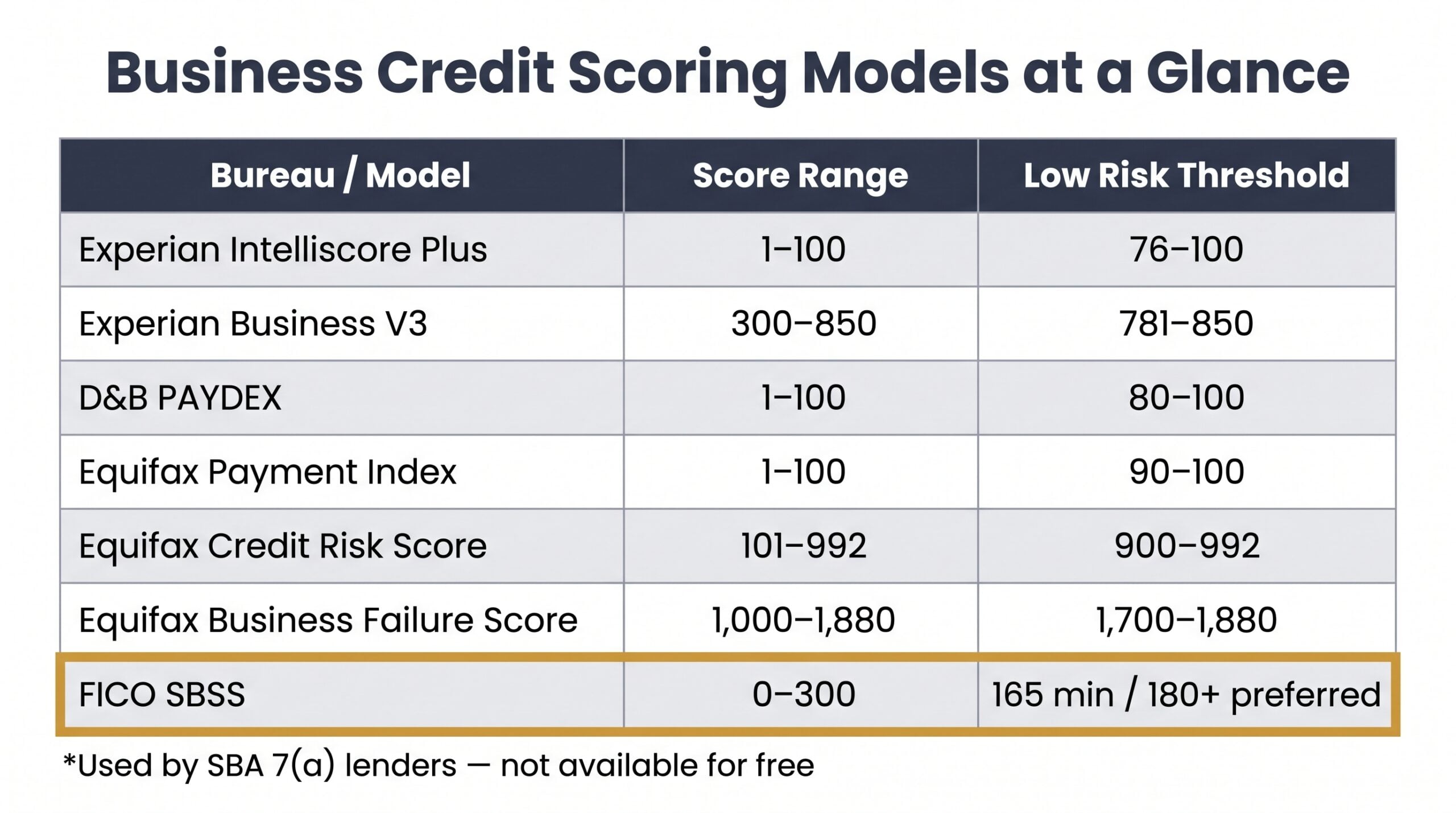
Most guides mention Dun & Bradstreet and stop there. That’s incomplete, and it leaves you exposed. Four scoring models actually matter, and each lender may pull a different one.
Experian Intelliscore Plus
Experian runs two models. Intelliscore Plus scores 1–100. Their V3 model mirrors personal credit with a 300–850 range. Both are widely used by commercial lenders, making Experian business credit scores worth monitoring closely.
Dun & Bradstreet PAYDEX Score
PAYDEX scores 1–100 and measures payment history almost exclusively. An 80 means you pay on time. Above 80 means you pay early.
It’s a simple model, but lenders take it seriously. And there’s a detail buried in that simplicity that most owners miss, more on that below.
Equifax Business Credit Scores
Equifax runs three separate models simultaneously. Each measures a different risk dimension, so a single Equifax pull gives lenders three distinct data points on your business at once.
FICO Small Business Scoring Service (SBSS)
Here’s what most guides skip entirely. FICO SBSS is what SBA 7(a) lenders use. It combines your personal credit, business credit, and financial data into a single 0–300 score. The SBA minimum is 165. Most major lenders want 180 or higher. And you can’t check it for free anywhere, which makes it the most important score you’re probably not watching.
| Bureau / Model | Score Range | Low Risk Threshold |
|---|---|---|
| Experian Intelliscore Plus | 1–100 | 76–100 |
| Experian Business V3 | 300–850 | 781–850 |
| D&B PAYDEX | 1–100 | 80–100 |
| Equifax Payment Index | 1–100 | 90–100 |
| Equifax Credit Risk Score | 101–992 | 900–992 |
| Equifax Business Failure Score | 1,000–1,880 | 1,700–1,880 |
| FICO SBSS | 0–300 | 165 (SBA min), 180+ preferred |
Are Free Business Credit Scores the Same as What Lenders See?
Not exactly. Free business credit scores give you a consumer-facing summary, not the full bureau report a lender pulls. The score you see through a free tool may use a simplified model or show a snapshot from one bureau only.
Lenders pulling directly from Experian or D&B get more granular data, trade line details, payment trend history, industry risk comparisons. SBA lenders bypass all of that and go straight to the FICO SBSS, which you can’t check for free anywhere.
That gap is real. But it doesn’t make free business credit scores useless.
Quick reality check: Free scores are directionally accurate. If your score looks bad on a free tool, it looks bad to lenders too. Use free business credit scores to identify problems early, not to predict an exact approval number.
Think of free score tools as a dashboard warning light. They tell you something needs attention. A full bureau report tells you exactly what’s wrong. Both have a role, don’t skip the free step just because it’s not the complete picture.
How to Get Your Free Business Credit Score (Step-by-Step)
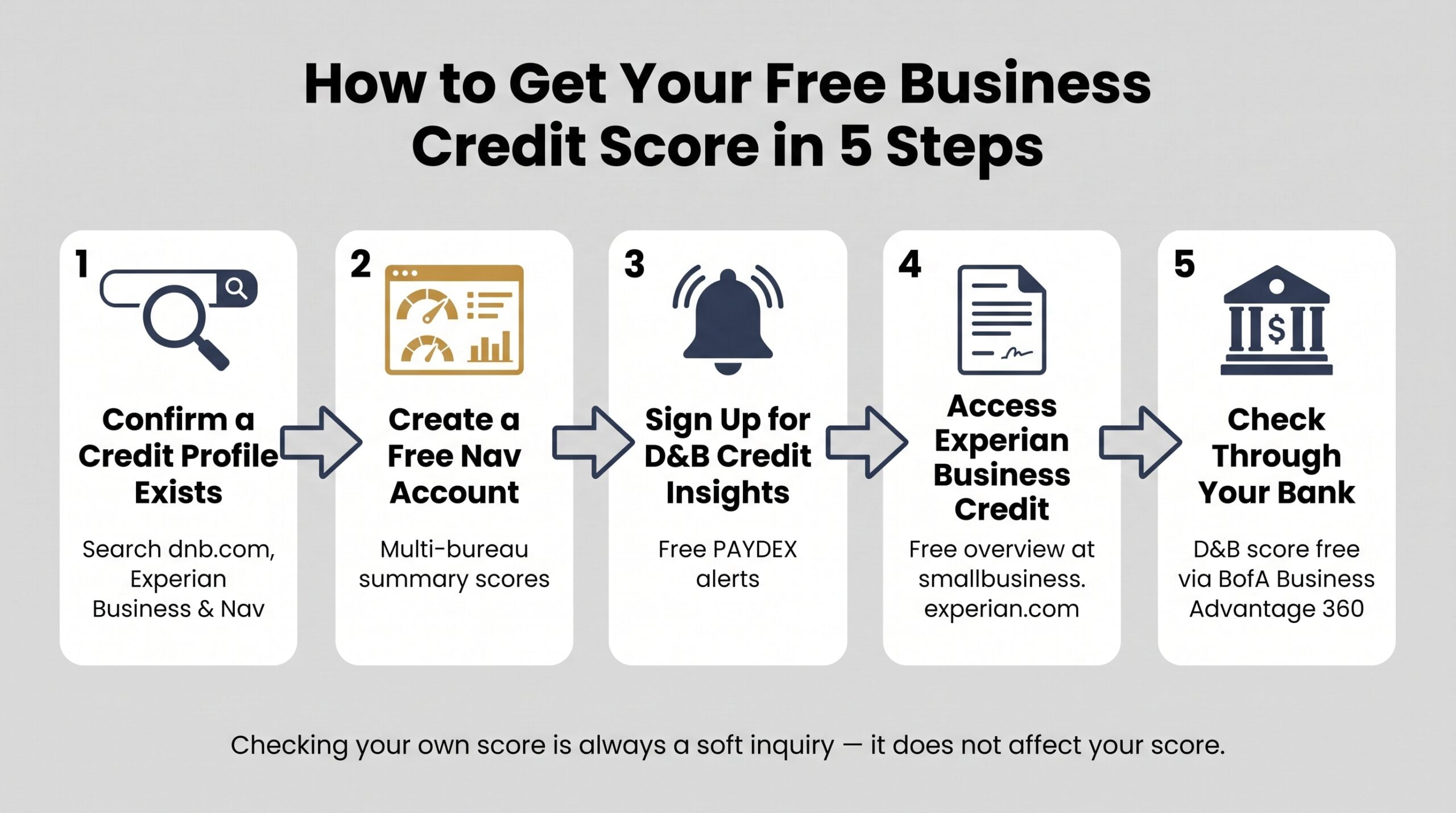
You can access free business credit scores in under 10 minutes. Here’s exactly how.
Step 1: Check if Your Business Has a Credit Profile
Before you check your score, confirm a profile exists. Search your business name on dnb.com, Experian’s business lookup, and Nav. No profile means no score, and you’ll need to build one first before any of the steps below matter.
Step 2: Create a Free Nav Account
Nav’s free dashboard aggregates summary scores from Experian, Equifax, and D&B in one place. It’s the fastest way to get a multi-bureau overview. Exact numeric scores require Nav Prime, but the free tier shows enough to spot red flags.
Step 3: Sign Up for D&B Credit Insights
D&B’s free tier delivers PAYDEX alerts and key payment metrics. Detailed reporting unlocks at $49/month, but the free alerts alone are worth setting up; you’ll know when your score moves without paying for anything.
Step 4: Access Experian Business Credit
Visit smallbusiness.experian.com for a free overview of your Experian business credit scores. A full report runs $39.95–$49.95, but the free summary shows your score tier and basic risk indicators. It’s a solid starting point.
Step 5: Check Through Your Bank or Lender
Bank of America Business Advantage 360 clients get D&B scores at no cost. Other banks offer similar perks; check your online business banking dashboard before paying for anything elsewhere.
Important: Checking your own business credit is always a soft inquiry. It does not hurt your score.
Best Free Tools to Check Your Business Credit Score (Comparison)
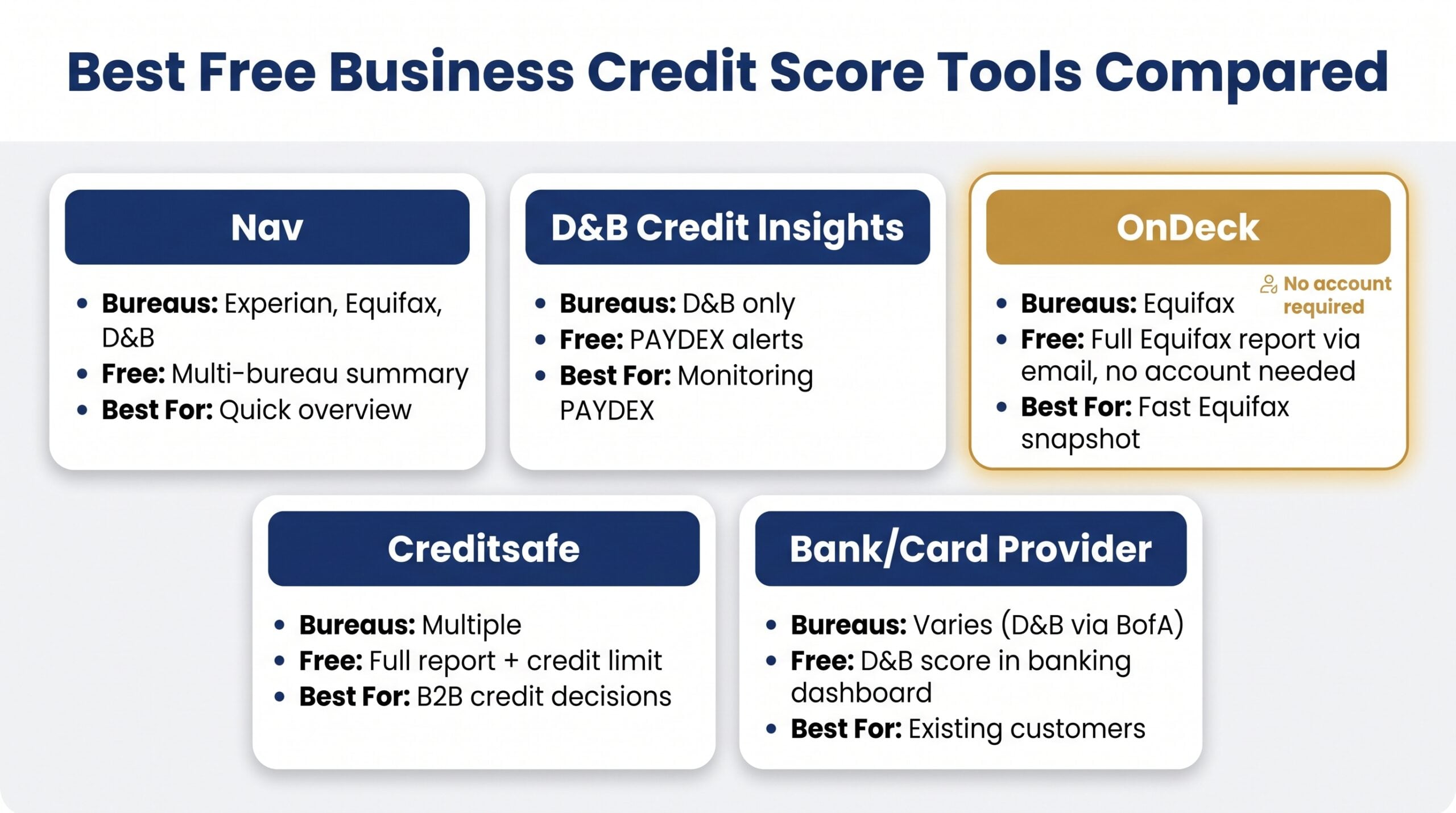
Not all free tools are equal. Here’s exactly what each one gives you, and where each one falls short.
| Tool | Bureaus Covered | What You Get Free | Limitations | Best For |
|---|---|---|---|---|
| Nav | Experian, Equifax, D&B | Multi-bureau summary, grade indicators | No exact numeric scores on free tier | Quick multi-bureau overview |
| D&B Credit Insights | D&B only | PAYDEX alerts, key payment metrics | Detailed reports require $49/month | Monitoring PAYDEX changes |
| OnDeck | Equifax | Full Equifax score report via email, no account needed | Single bureau only | Fast Equifax snapshot |
| Creditsafe | Multiple bureaus | Full report plus suggested credit limit | Business users only, not consumer-facing | B2B credit decisions |
| Bank/Card Provider | Varies (D&B via BofA) | D&B score inside banking dashboard | Only available to existing account holders | Zero-effort monitoring for existing customers |
Nav
Nav is the closest thing to a free business credit scores hub. You get Experian, Equifax, and D&B summaries in one dashboard. The trade-off is that exact numeric scores sit behind the Nav Prime paywall, but the free tier is still the best starting point for most owners.
Dun & Bradstreet Credit Insights
D&B’s free tier is worth setting up purely for the PAYDEX alerts. You’ll know immediately when your score changes, without paying for a full plan. Set it up once and let it run in the background.
OnDeck
OnDeck sends a free Equifax business credit report straight to your email. No account required. It’s the fastest way to get an Equifax snapshot without signing up for anything.
Creditsafe
Creditsafe is built for businesses evaluating vendors and clients, not individual owners checking their own profile. If you’re in that context, assessing a supplier or potential partner, it’s one of the most complete free tools available.
Your Bank or Credit Card Provider
Check your business banking dashboard before paying for anything. Bank of America Business Advantage 360 clients get D&B scores at no cost, and other providers are quietly adding similar perks. It takes 30 seconds to look.
What’s Actually on a Business Credit Report?
Your score is just one number on a much longer document. When a lender pulls your full report, here’s what they’re actually reading:
- Company identifying information: Legal business name, address, phone, EIN, and DUNS number
- Payment history and tradelines: Every vendor, supplier, and lender that reports to the bureaus, plus how quickly you paid
- Public records: Judgments, tax liens, and bankruptcies, these hit hard and stay visible
- Industry risk classification: Your SIC or NAICS code affects how your score is benchmarked
- Credit utilization: How much of your available credit you’re actively using
- Inquiries: Which lenders and vendors have pulled your report recently
Here’s the part most owners don’t realize: business credit reports are public record. Your competitors, your vendors, and anyone considering doing business with you can pull this data right now, without asking, without notifying you. Free business credit scores give you a window into what they’re already seeing.
How to Establish a Business Credit Profile From Scratch
If your free business credit scores search turns up nothing, you don’t have a profile yet. That’s fixable. Here’s how to build one.
Get a DUNS Number (Free)
Apply at dnb.com. Standard processing takes up to 30 business days at no cost. Expedited 8-day processing runs $229. Start with free unless you’re on a tight funding deadline; paying $229 to save a few weeks rarely makes sense unless a deal is actually on the table.
Separate Business and Personal Finances
Commingled finances confuse bureau reporting and hurt your credibility with lenders. Keep them cleanly separated from day one. This isn’t just bookkeeping hygiene; it’s the foundation your business credit profile is built on.
Open a Business Bank Account
A dedicated business checking account confirms your business operates as a separate entity. Most lenders require this before approving any credit.
Apply for a Business Credit Card or Net-30 Account
Net-30 vendor accounts with suppliers like Uline, Quill, or Grainger report to D&B and Experian. These are often the fastest way to start building tradelines, and you don’t need strong credit to get approved for most of them.
Pay Early, Not Just On Time
This is the D&B PAYDEX detail most owners miss. Paying on time only gets your PAYDEX to 80. Paying before the due date pushes it toward 100. The distinction matters when lenders are comparing applicants side by side.
Once you’ve built a profile, check what credit score you need for a business loan to understand exactly where you need to land before applying.
What Factors Affect Your Business Credit Score?
Free business credit scores don’t exist in a vacuum. These are the factors driving the number up, or pulling it down:
- Payment history: The single most weighted factor across every bureau. Late payments damage scores fast and linger longer than most owners expect.
- Credit utilization: High balances relative to your credit limits signal financial stress to lenders.
- Length of credit history: Older accounts strengthen your profile. A two-year-old business starts at a disadvantage.
- Public records: Tax liens, judgments, and bankruptcies are severe negative marks that can take years to recover from.
- Company size and industry risk: Experian Intelliscore factors in your industry’s default rate. High-risk industries start with a headwind before a single payment is made.
- Number of tradelines: More reporting accounts mean more data, which generally improves score stability.
- Credit inquiries: Hard pulls from lenders accumulate and can signal credit-seeking behavior.
One distinction worth keeping in mind: D&B PAYDEX is almost entirely payment-history based. Pay early, score high. Experian Intelliscore weighs all of the factors above, making it harder to move quickly and harder to game with a single tactic.
How Often Are Business Credit Scores Updated?
It depends on the bureau, and the answer matters more than most people think.
- Experian: Updates business reports continuously. Daily monitoring is available on paid plans, but the underlying data refreshes in near real-time as creditors report.
- D&B: Updates when creditors submit new data, typically on a monthly cycle. Your PAYDEX score recalculates at the time of each request based on the most recent 12 months of payment data.
- Equifax: Follows a similar monthly reporting schedule, with scores recalculated at the point of inquiry.
Scores aren’t static snapshots. They reflect the latest reported data at the moment someone pulls them. A payment you made last week may already be factored in.
Check your free business credit scores at least once per quarter. If you’re actively applying for financing, check monthly; there shouldn’t be any surprises when a lender pulls your report.
How to Improve Your Business Credit Score
Pay Early or On Time Every Time
Payment history drives every bureau’s scoring model. For D&B specifically, early payment is the difference between an 80 and a 100. Set up autopay or calendar reminders and treat vendor invoices like loan payments, because in terms of your credit profile, that’s exactly what they are.
Keep Credit Utilization Low
Stay below 30% of your available credit across all business accounts. High utilization signals cash flow problems even when there aren’t any, and lenders don’t know the difference from a report alone.
Add More Tradelines
More reporting accounts mean more positive data points. Net-30 vendor accounts with Uline, Quill, or Grainger are low-barrier ways to add tradelines that report directly to D&B and Experian.
Monitor and Dispute Errors
Business credit reports contain errors far more often than personal ones, because business data reporting is less regulated. Check your free business credit scores regularly and challenge anything inaccurate.
- Experian: Use the Submit Data Dispute button at smallbusiness.experian.com or email BusinessDisputes@Experian.com. Resolution typically takes 30 days.
- D&B: Contact D&B directly through your Credit Insights dashboard to flag incorrect tradelines or company data.
- Equifax: Contact Equifax Business directly to initiate a dispute on commercial report data.
Once your score is moving in the right direction, review the minimum credit score requirements for a business loan to know exactly what threshold you’re building toward.
Business Credit Score vs. Personal Credit Score: Key Differences
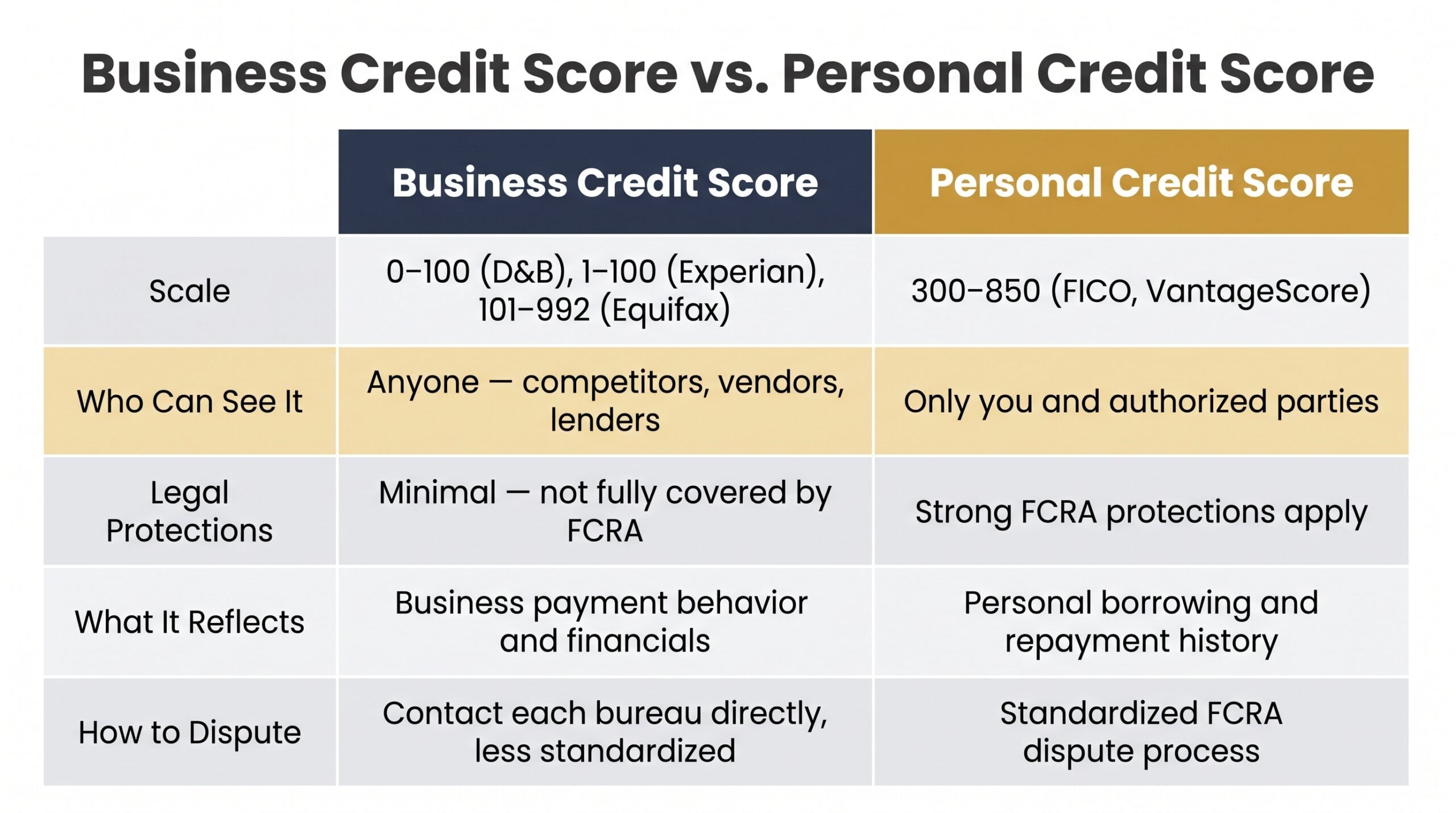
These two scores work differently in almost every way that matters. Most new business owners conflate them, and that creates serious blind spots when it’s time to apply for financing.
| Factor | Business Credit Score | Personal Credit Score |
|---|---|---|
| Scale | 0–100 (D&B), 1–100 (Experian), 101–992 (Equifax) | 300–850 (FICO, VantageScore) |
| Who Can See It | Anyone: competitors, vendors, lenders | Only you and authorized parties |
| Legal Protections | Minimal: not covered by FCRA in the same way | Strong FCRA protections apply |
| What It Reflects | Business payment behavior and company financials | Personal borrowing and repayment history |
| How to Dispute | Contact each bureau directly, less standardized | Standardized FCRA dispute process |
The public nature of business credit catches most owners off guard. Unlike personal credit, anyone can pull your business report right now, without your knowledge, without your consent.
For new businesses without an established credit history, lenders typically fall back on the owner’s personal credit score to assess risk. It’s a gap that free business credit scores monitoring alone won’t solve. Learn more about how business credit works vs. personal credit and how profiles are built from the ground up.
Frequently Asked Questions
Can I check my business credit score for free?
Yes. Experian offers a free business credit score through its Business Credit Advantage trial. Nav provides free business credit scores from multiple bureaus. Dun & Bradstreet also offers free access to your PAYDEX score through Credit Insights. None of these require a credit card to get started.
Does checking my business credit score hurt it?
No. Checking your own business credit score is always a soft inquiry. It has zero impact on your score regardless of how often you check it.
How long does it take to build a business credit score?
Plan for at least 12 months of consistent payment activity across multiple tradelines before you have a score lenders take seriously. Starting with net-30 vendor accounts accelerates this process.
What is a good business credit score?
It depends on the bureau. Aim for 76–100 on Experian Intelliscore, 80–100 on D&B PAYDEX, and 900–992 on the Equifax Business Credit Risk Score. Each bureau uses a different scale, so context always matters.
Do I need a business credit score to get a business loan?
Not always, but it helps significantly. Many lenders will use your personal credit score as a substitute if your business has no credit history. Established business credit scores free you from that personal liability dependency over time.
Is a business credit score the same as a personal credit score?
No. They use different scales, different data, and different rules. Business credit is publicly accessible. Personal credit is private and protected by federal law. New business owners often conflate the two, and it leads to real blind spots when applying for financing.
You now know exactly where to get free business credit scores, what each tool actually shows you, and what to do once you have the number. Start by pulling your score from Nav or Experian today, then use what you find to close any gaps before your next funding application. The information is free. The advantage it gives you is real.

Founder of Nanotom Capital & Nanotom Labs